
Ambi'Son


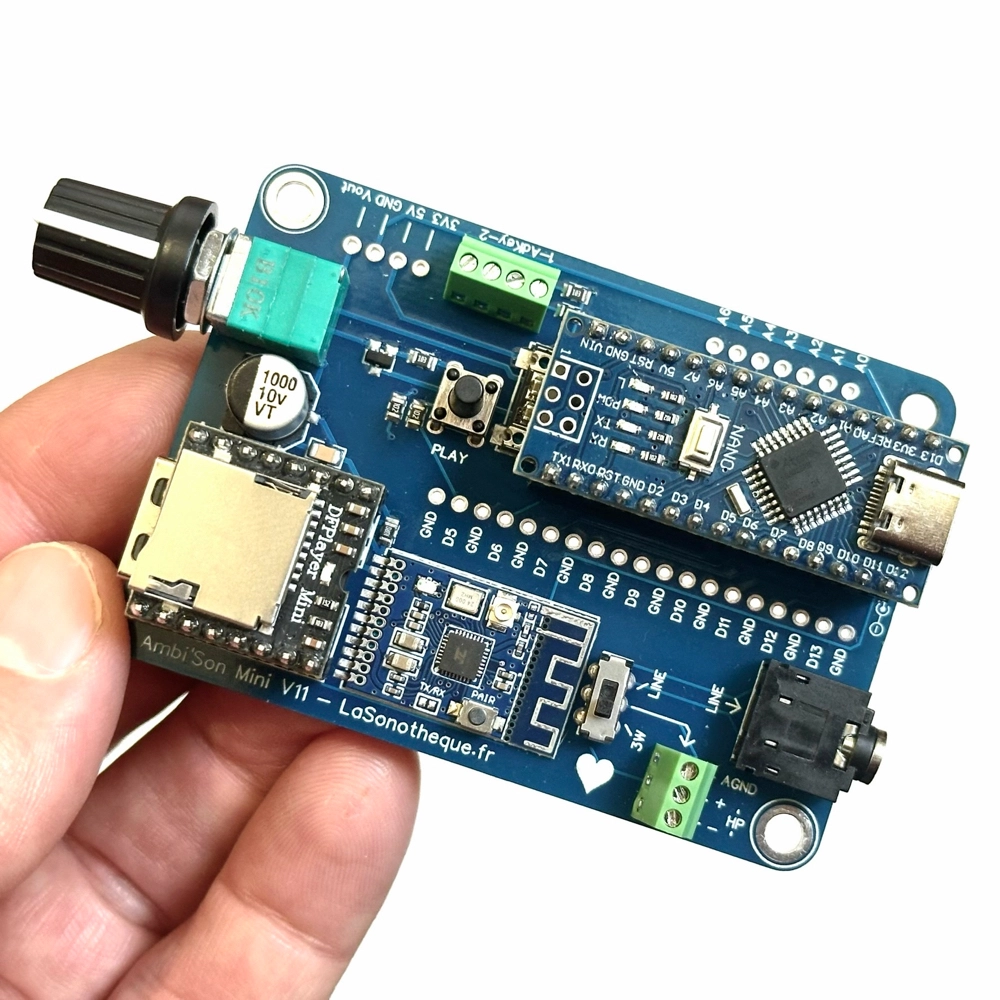
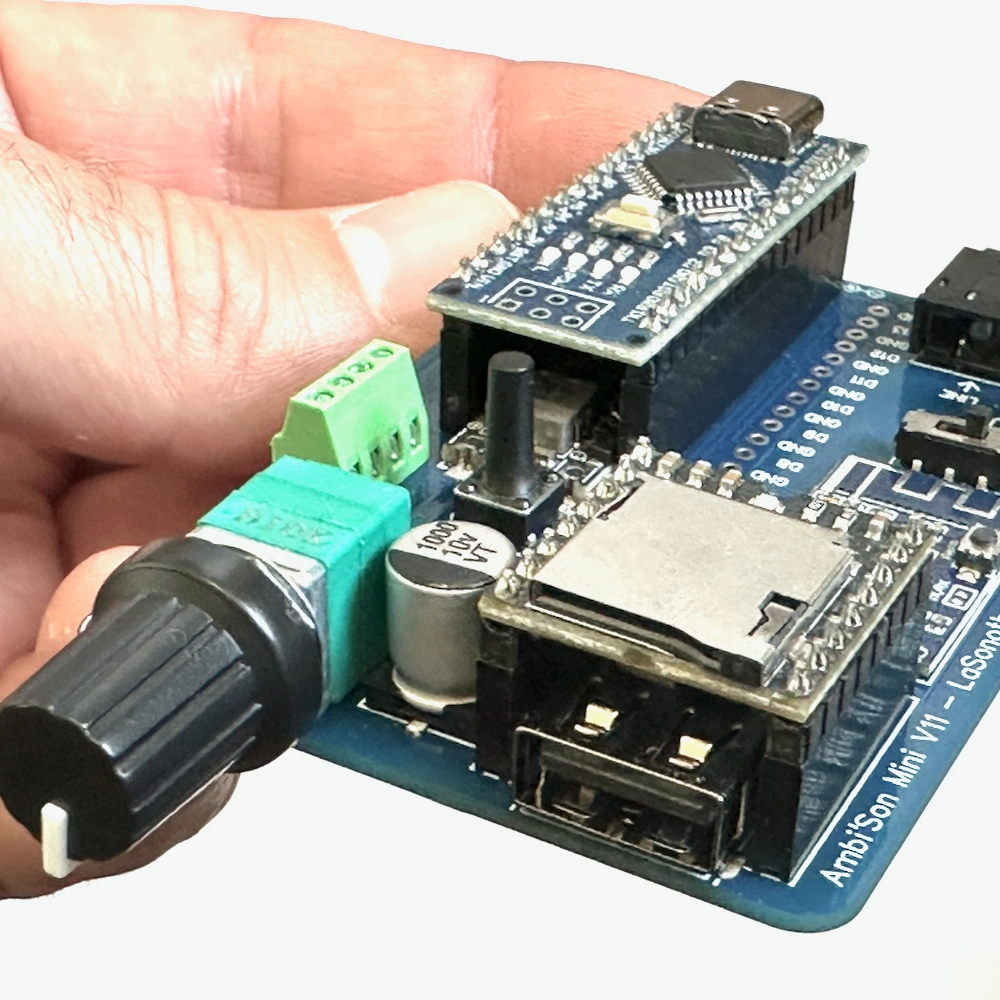
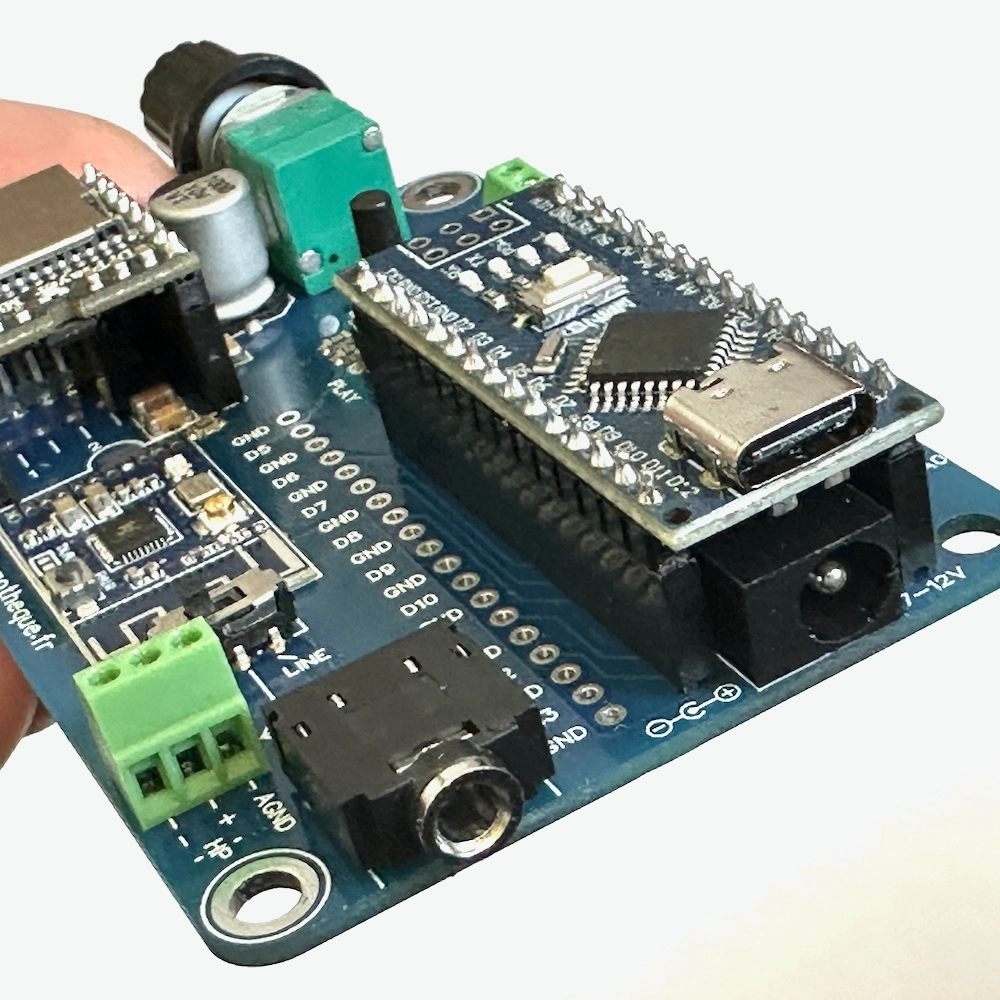
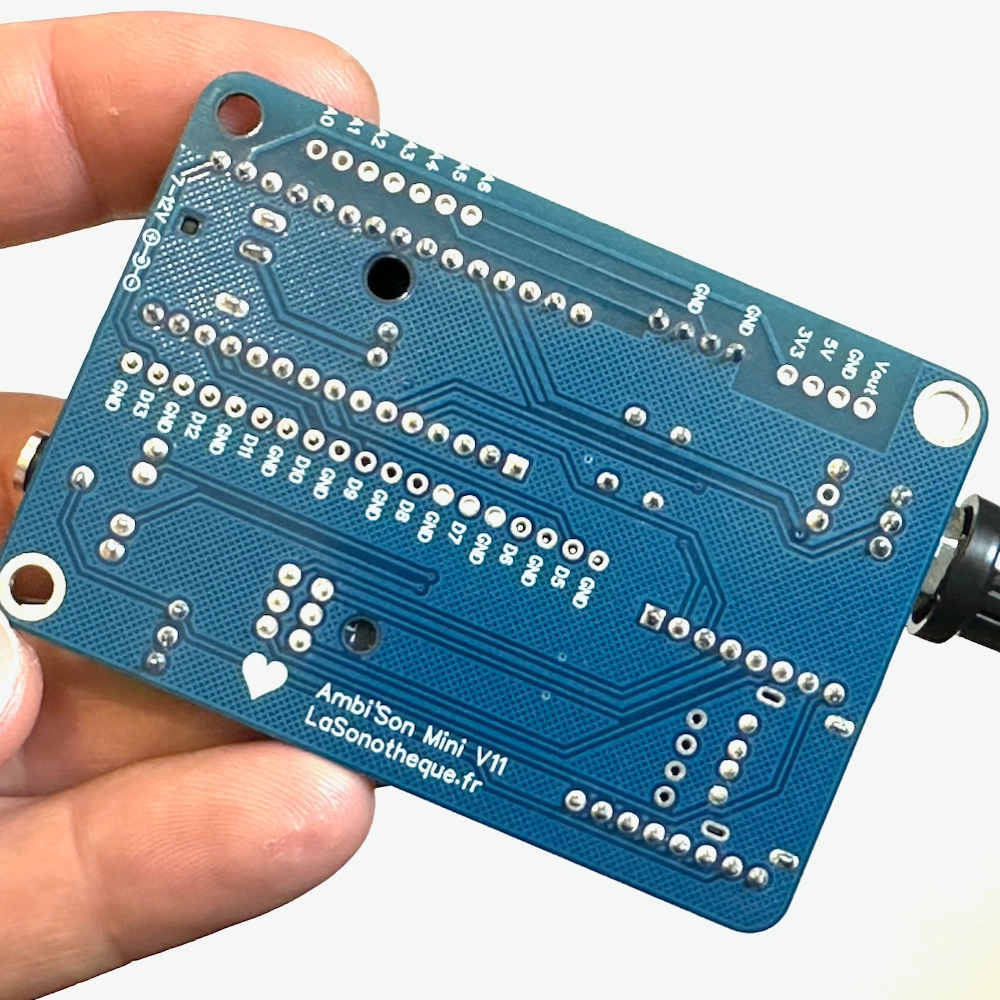

Ambi'Son is a standalone, reprogrammable audio player: looping ambience, sounds triggered by buttons or sensors, relay control. Handmade by me.
What it can do
- Play on its own: as soon as it is switched on, it plays your sounds on a loop, at random or in order, with no intervention at all. Ideal for the ambience of a room, a shop window or a set.
- React to visitors: pressing a button plays a sound. With the options, each button plays its own: up to 20 with Exten'Son boards, up to 128 with Expan'Son boards.
- Go further: its brain is a reprogrammable Nano. Sensors, RFID reader, lights, relays: everything can be built around your project.
- No programming needed: it comes ready to use, with a preloaded program. Just copy your sounds (MP3 or WAV) onto a microSD card or a USB stick.
Museums, set design, escape games, story boxes, repurposed objects, model making: answer a few questions and the steps write themselves. Or tell me about your project and I will take care of everything.
Simple use
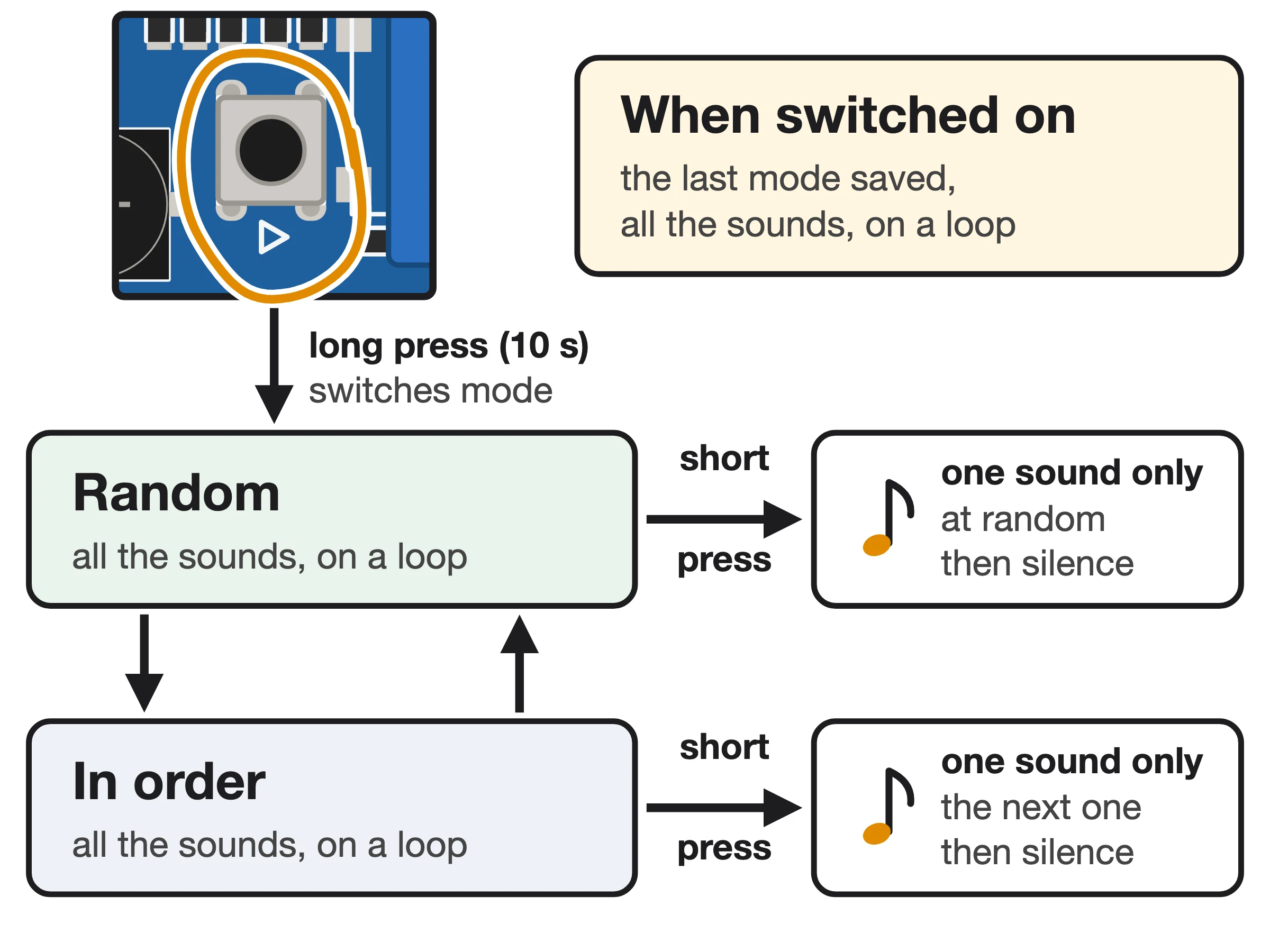
- When switched on: it automatically resumes the last mode used (random or in order), on an endless loop. By default: random (no repeats until every file has been played).
- Short press: plays a single file in the current mode (a random file or the next one), then silence.
- Long press (10 s or more): switches to the other mode (random ↔ in order), which starts again on an endless loop.
- Mode memory: the last mode chosen is kept, even after a power cut.
Wiring, settings and tips: read the full user manual.
Need it to work in a particular way? Feel free to contact me.
Choosing your options
The player works out of the box. The options are not required.
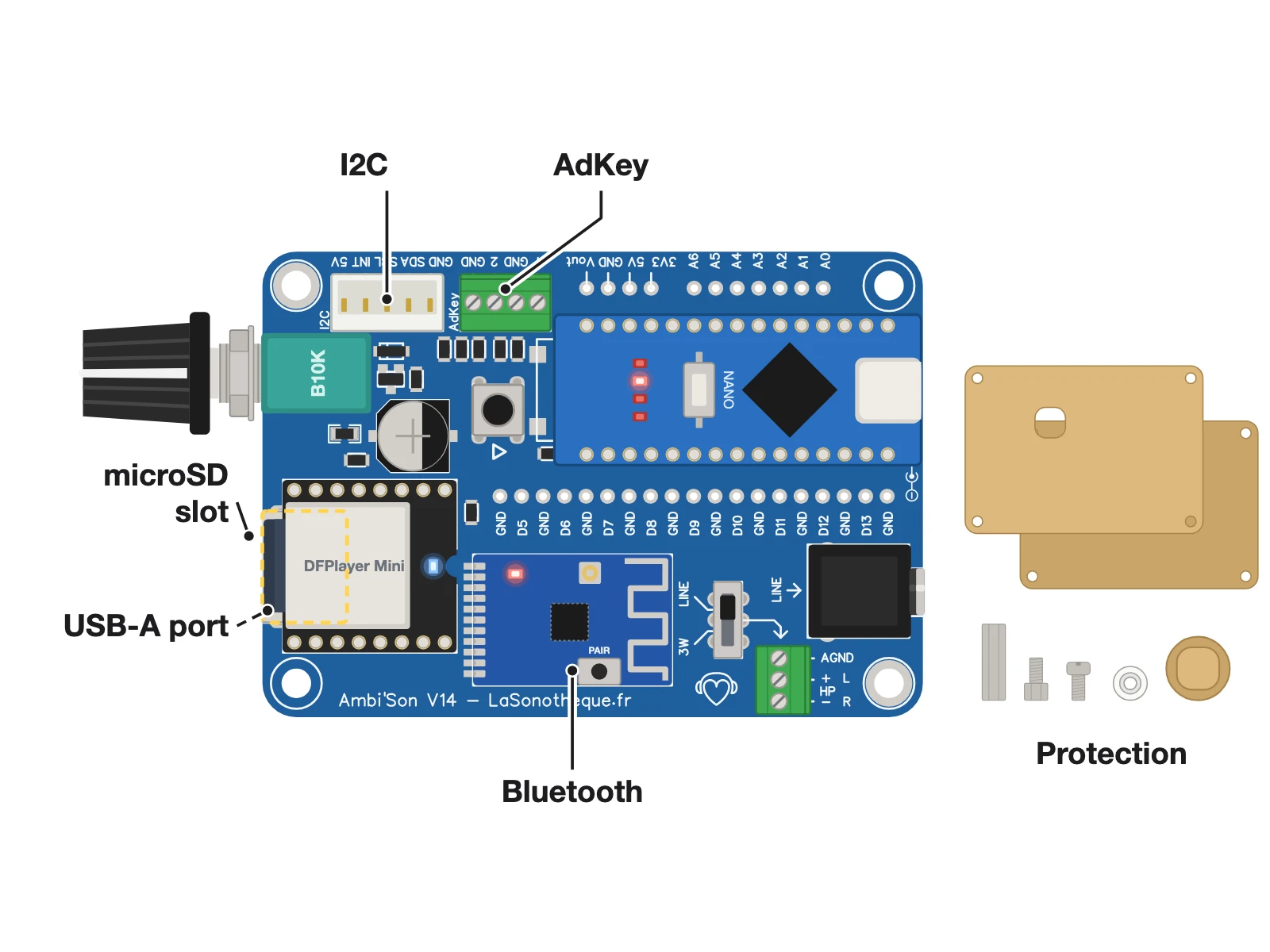
- microSD slot: microSD card reader, included on every version.
- USB-A port: adds a USB-A socket to play the audio files on your USB stick.
- Bluetooth: adds a wireless audio output for a speaker or headphones.
- AdKey: to easily add buttons with 1 or 2 Exten'Son boards.
- I2C: socket for connecting 1 to 8 Expan'Son boards.
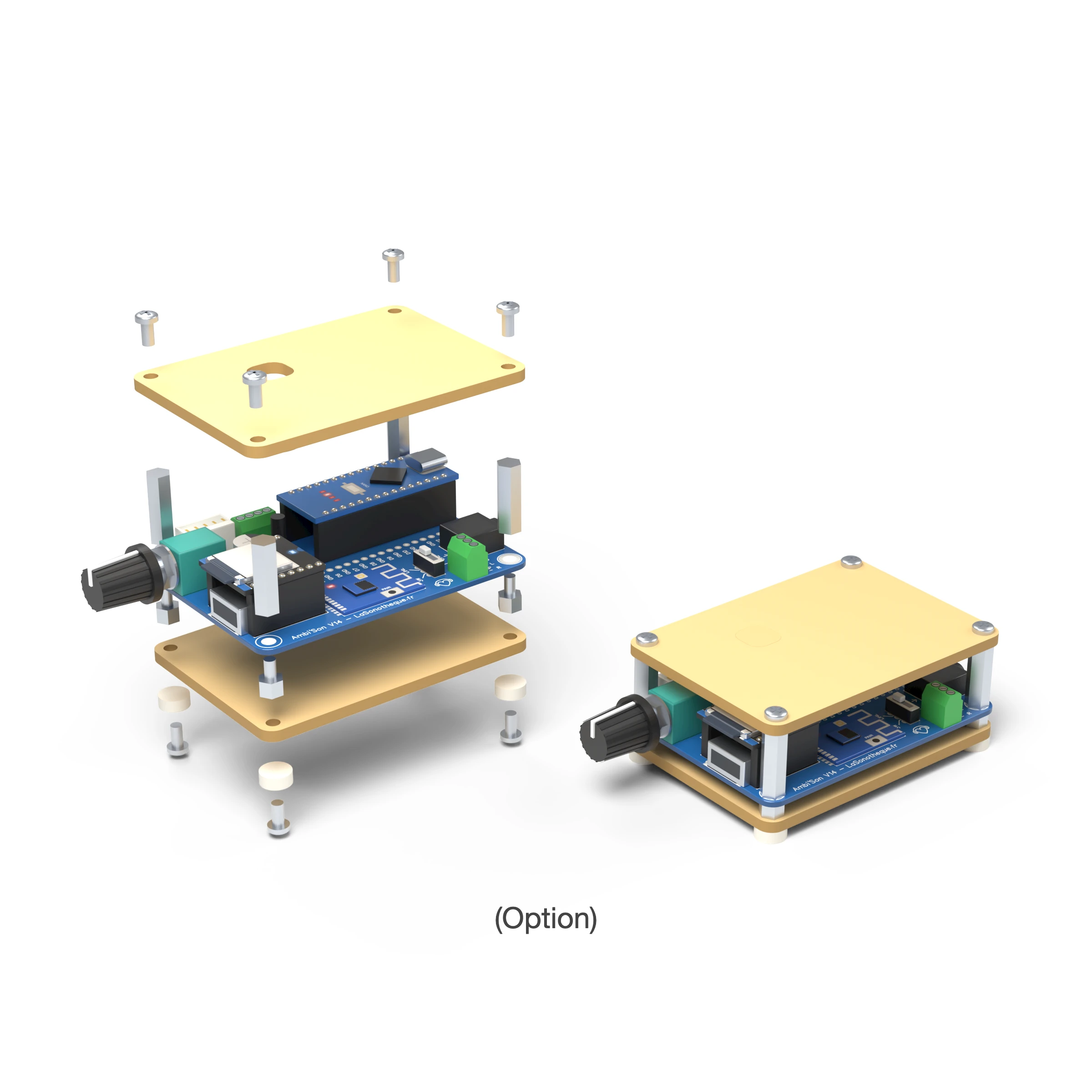
- Protection: self-assembly kit that protects your Ambi'Son's circuit. Watch the video.
For a simpler, cheaper module, see the Exposi'Son. Need help choosing between the two?
Museum, local authority or business: quotes and invoices on request.
From
39,00 €
This article is in stock :)
Additional information
All kinds of projects are possible. Need advice (feasibility, choice of version, build, suggestions, questions...)? Contact me. And if you would like my help to tinker, I welcome you in my workshop.
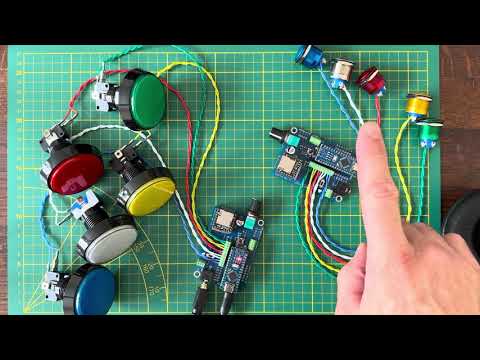
Here are a few examples of what you can do with it:




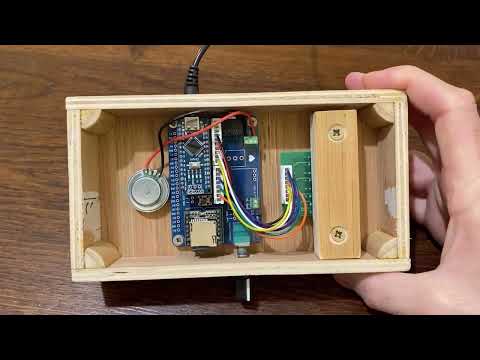


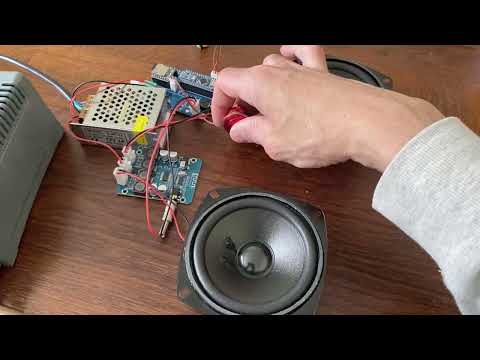

Protection, optional
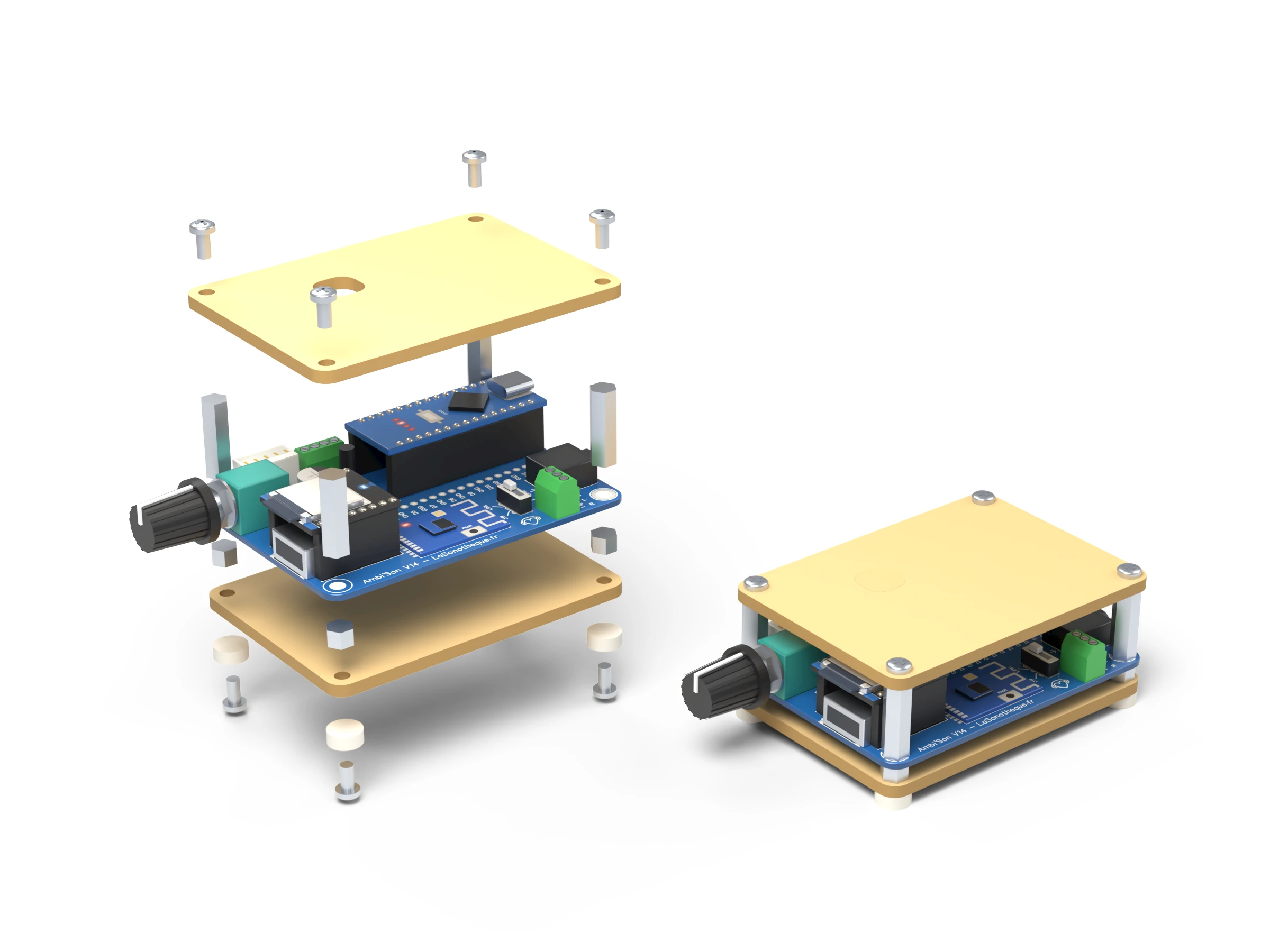
Like all similar boards (Bare Conductive's "Touch Board", the "Teensy Audio Shield" or Adafruit's "Audio FX Sound Board", for example), the Ambi'Son comes bare, without a case. Simply place it in a case or under a protection, away from anything conductive.
I now offer a protection kit made of 2 laser-cut wooden plates, 1 wooden extension for the push button, 8 spacers, 8 screws and 4 feet, to protect the circuit. It is a kit to assemble yourself.
The kit protects the top and the bottom of the board; its sides stay open, to reach the volume, the sockets and the microSD card. Other protections are gathered on the Enclosures and cases page, with their files so you can make them yourself: the wooden kit, to laser cut, and a closed enclosure, to 3D print, which visitors cannot open (designed for the next version of the board).
Power supply
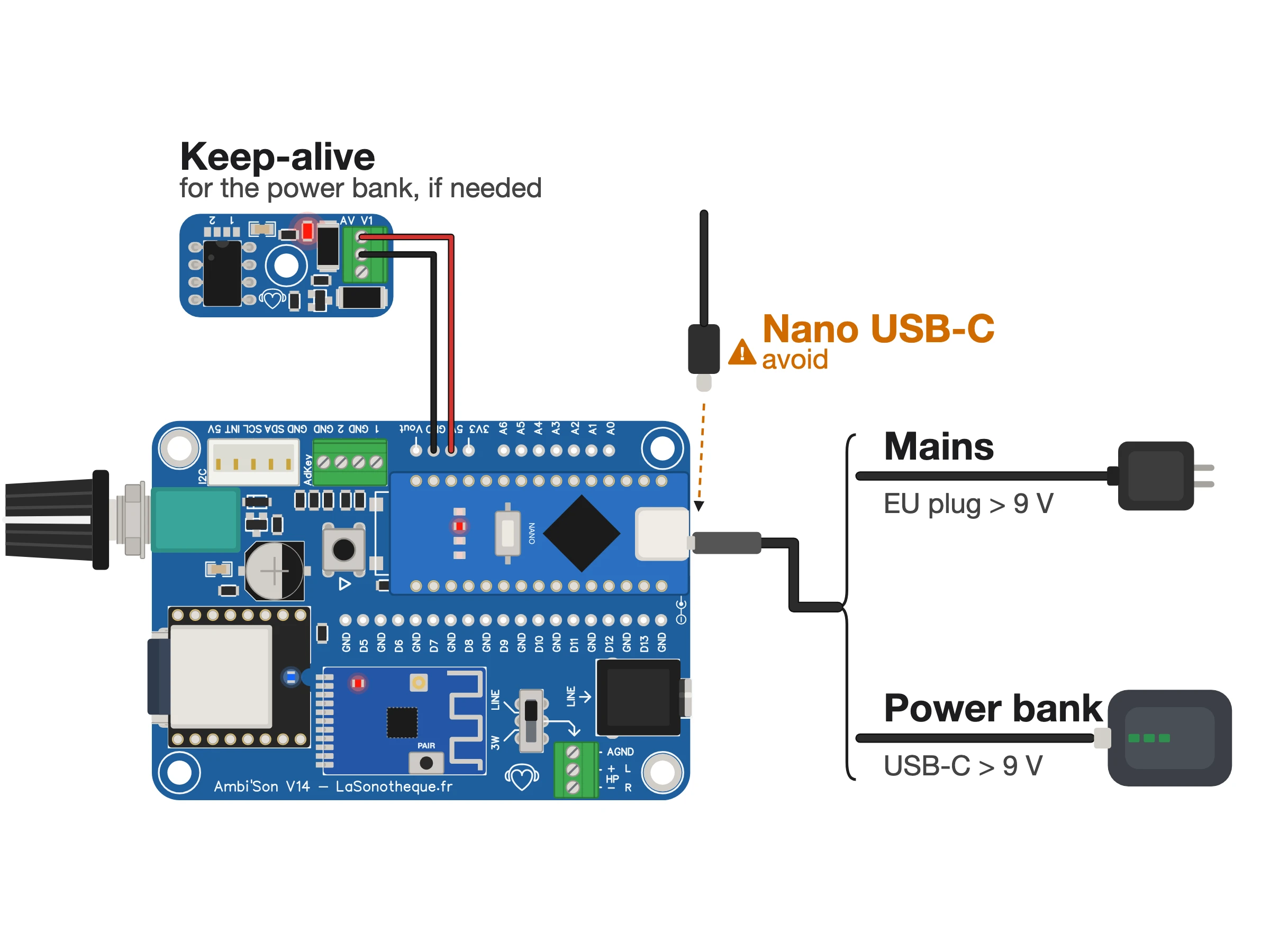
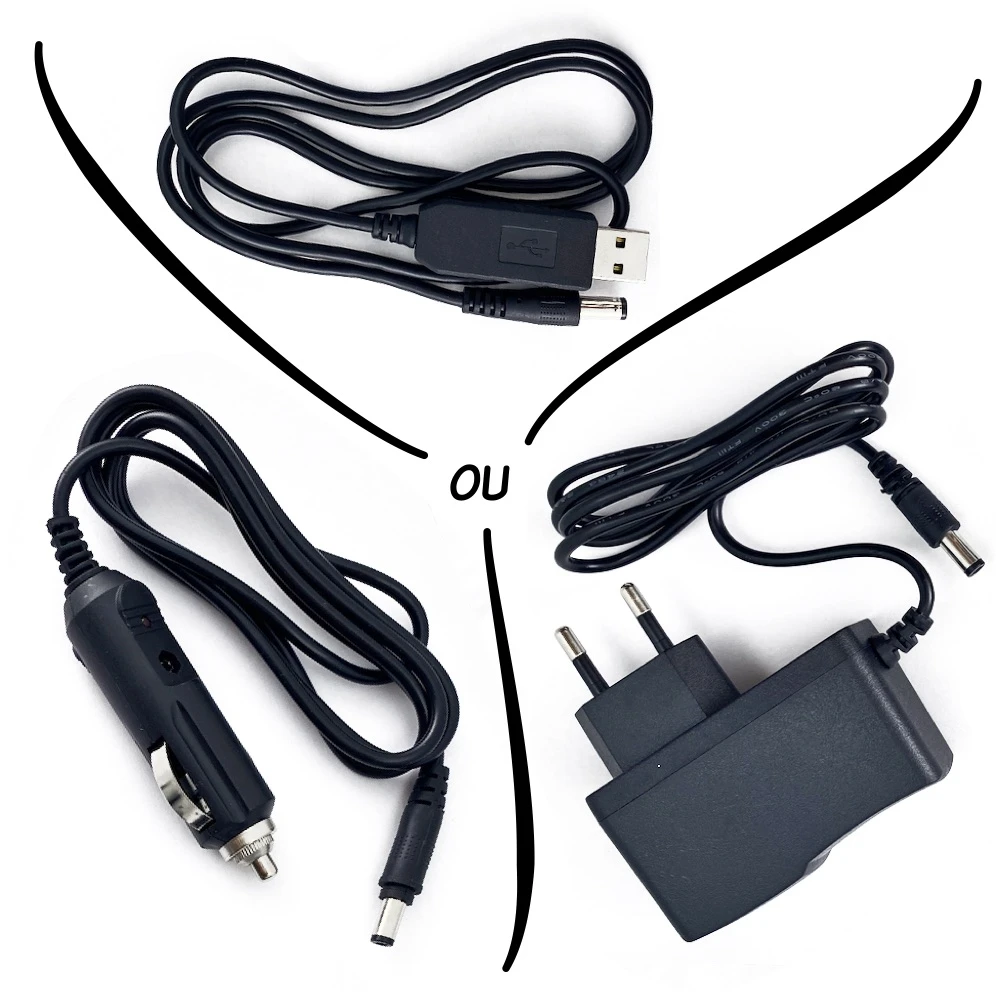
I recommend powering the Ambi'Son through its DC socket (5.5 × 2.1 mm, known as "DC5521"): from the mains with a DC power supply in its "Prise Europe > 9V" version (EU plug), or from a power bank with the "USB-C > 9V" version. Avoid the Nano's USB-C: the potentiometer's switch no longer cuts the power, and the Vout, 5 V and 3.3 V outputs are not available.
On a power bank, one thing to know: standby. When idle or with headphones, the Ambi'Son draws very little current (about 35 to 40 mA). Some power banks switch their output off when the draw is this low, for example with headphones, at low volume or during the silences between two playbacks. The module then stops without warning.
- Got time? First test your power bank on its own, in real conditions: same audio output, same volume, and leave the module idle for a good while. If it does not cut out, you are all set.
- No time to test, or nothing must stop? Add a keep-alive: it keeps the power bank switched on, with no setting at all.
Some power banks offer an "Always-on" or "low current" mode (designed for connected devices): if yours has one, turn it on, it may be enough.
Volume
The volume is set with the potentiometer, from 0 to 100 %. Turned fully to the left, until it clicks, it also switches the module off (only when powered through the DC socket or the screw terminal, not through the Nano's USB-C).
Handy, but a double-edged sword in a public place: a visitor may turn the sound down to the minimum, or even switch the unit off by accident. On request, I can fit a potentiometer without a switch and raise the minimum volume to 10 or 20 % in the program. That way, the unit always stays audible.
Adding buttons


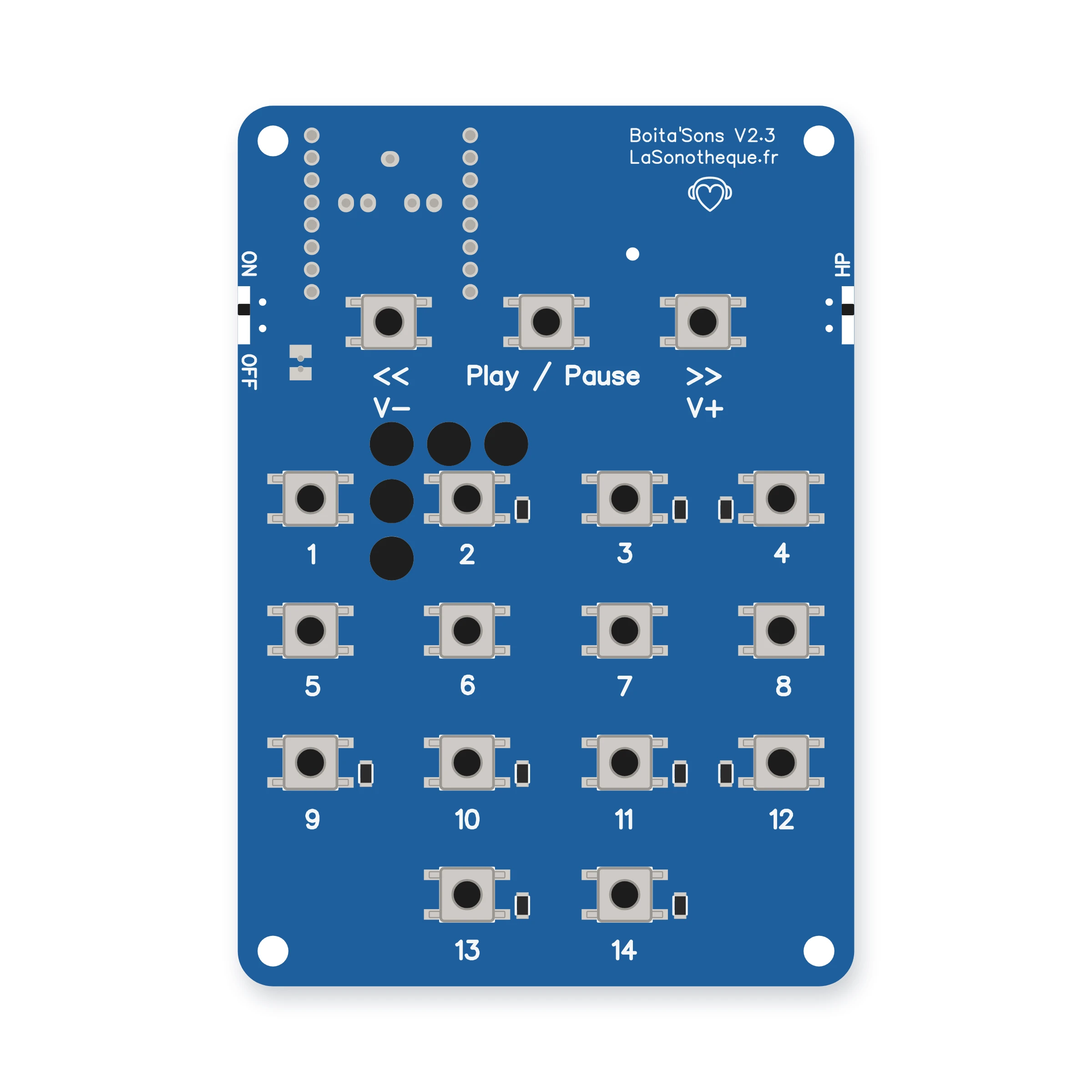
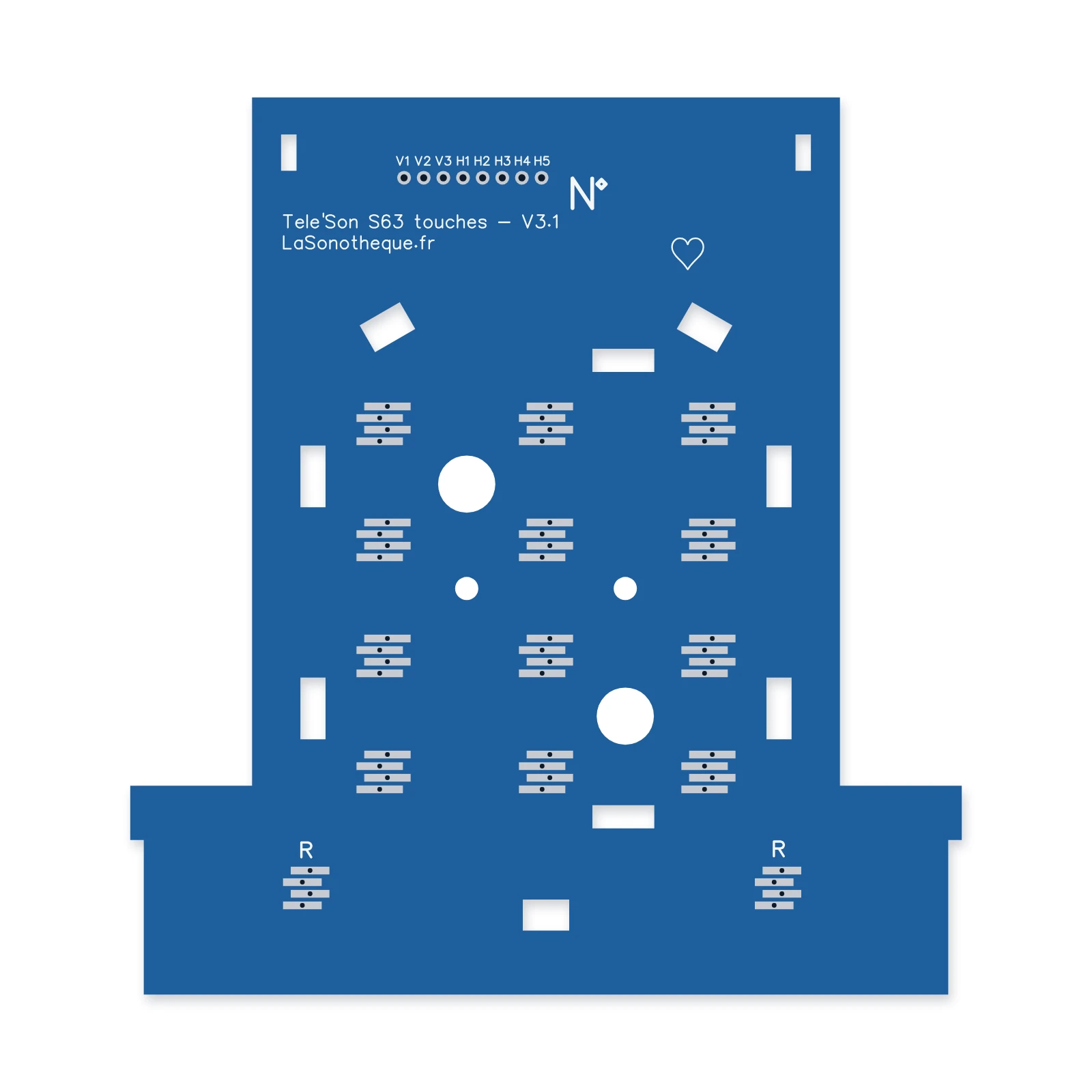
With the AdKey option, the Ambi'Son gets a screw terminal with two inputs, AdKey 1 and AdKey 2. On each of them, an Exten'Son lets you connect push buttons without any particular knowledge. With two Exten'Son boards, you get 14 buttons that each play their own sound, plus "previous", "next", "play / pause" and "loop all". On request, I set the program for 20 buttons that each play their own sound, without these controls.
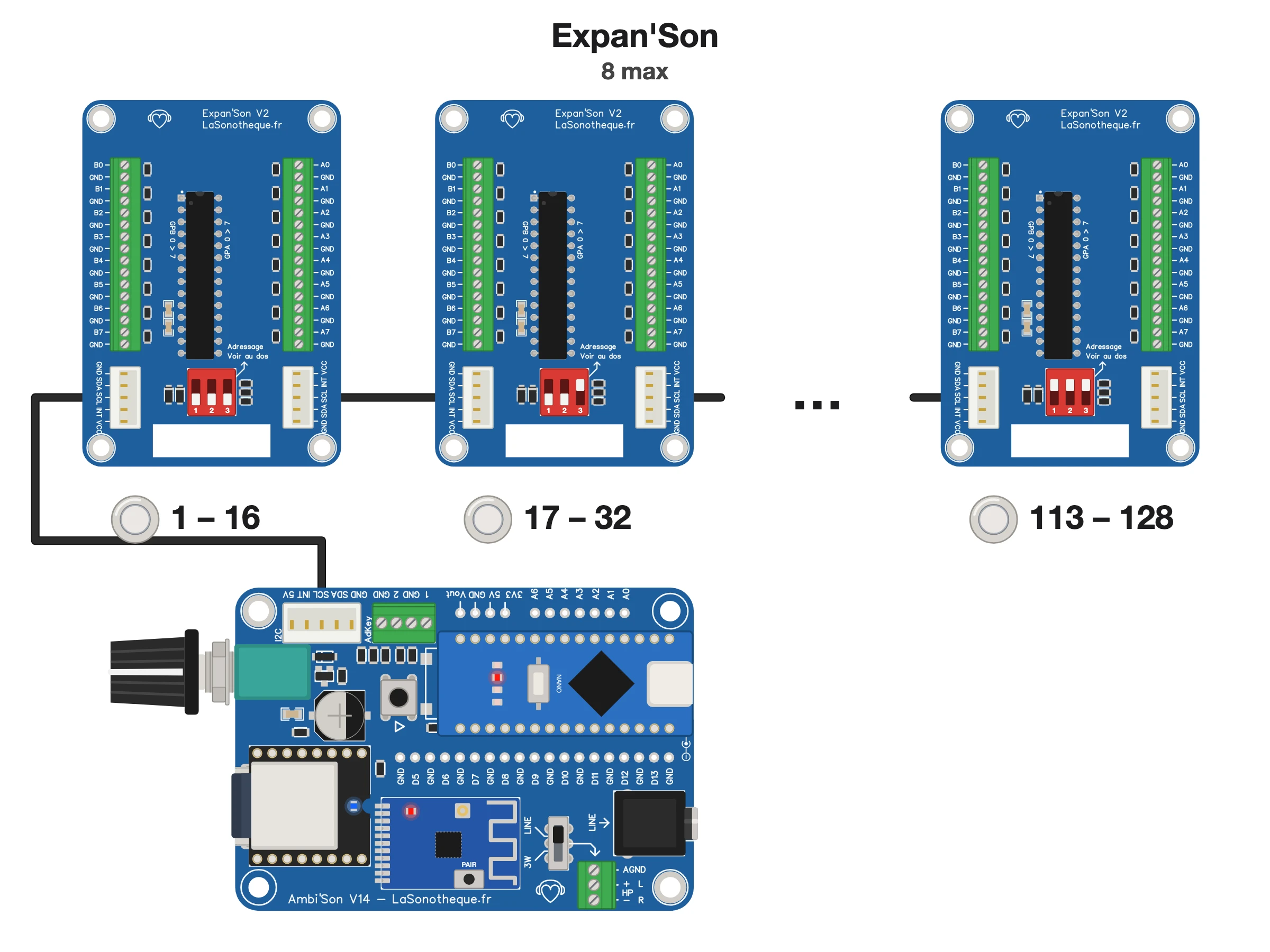
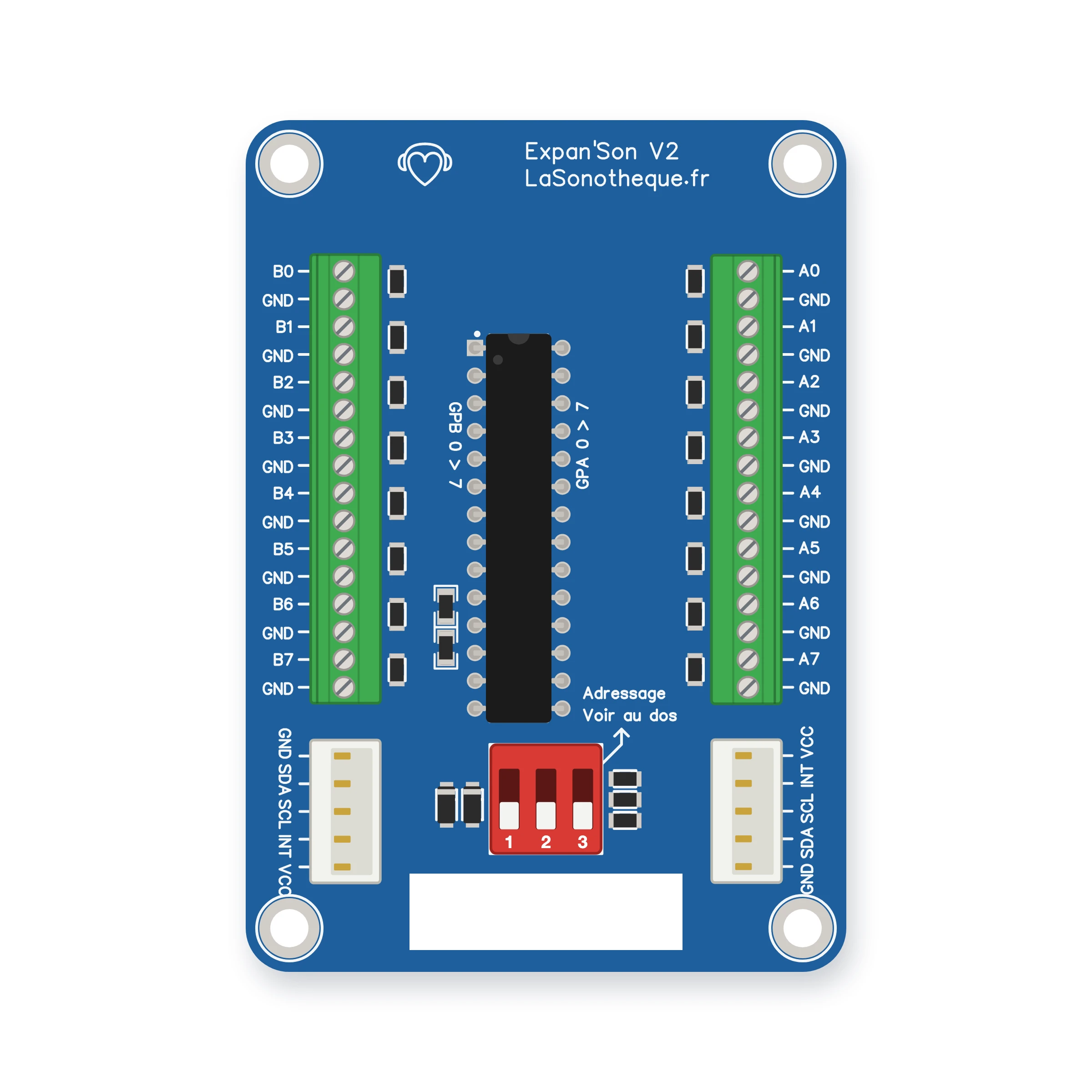
To go further, the I2C option adds a connector for Expan'Son boards: 16 buttons per board, and up to 8 boards daisy-chained, that is 128 buttons. Each board is set with its small switches, and the Ambi'Son recognises them by itself at start-up.
How many boards, and which button plays which file? Tell me how many sounds you want and the wiring table builds itself. All the details are in the user manual.
Museums, local authorities and businesses
I provide quotes and invoices on request, with submission through Chorus Pro for French public bodies, and payment by bank transfer (VAT not applicable, article 293 B of the French General Tax Code). As each module is made by hand, write to me for a bulk order: we will agree on the lead time together.
Detailed use
- Read the full user manual.
- Get your step-by-step guide: the options to order, the equipment, the files and the wiring, depending on what your installation needs to do.
You will find even more information further down this page.
Exposi'Son or Ambi'Son?
| Exposi'Son | Ambi'Son | |
|---|---|---|
| Sounds triggered by a button | Up to 14, using Exten'Son boards. | Up to 20 with Exten'Son boards, and up to 128 with Expan'Son boards. |
| Playback order | In file order. | In order or at random, as you prefer. |
| Audio output | Mono. Unamplified 3.5 mm jack, 3 W speaker or resonator, chosen when you order. | Stereo on the jack, or 3 W amplified mono on the terminal, chosen with a switch. Bluetooth optional. |
| Lights, relays, sensors | No: it only plays sounds. | Yes, through the Nano's D6 to D12 pins, or with Expan'Son boards. Requires programming the Nano. |
| Programmable | No: its behaviour is fixed. | Yes, through its Nano, an Arduino clone. Reprogrammable at will. |
| Power | USB-C, or 3.2 to 5 V: AA, AAA batteries or an 18650 cell. | 5.5 × 2.1 mm DC socket or screw terminal, 7 to 16 V. Or the Nano's USB-C (not recommended). |
| Best suited to | Temporary or travelling installations, or hiding inside a small object. | Permanent installations, and any project that has to react to its audience. |
Technical specifications
- Choose your options and set it up, in a few questions
- Full user manual
-
Power supply:
- Standard DC socket (5.5 × 2.1 mm, known as "DC5521"), 7 to 16 V DC, recommended: from the mains or a power bank (see "Power supply")
- Screw terminal, 7 to 16 V DC
- USB-C (through the Nano's interface), not recommended (see "Power supply")
- Inputs/Outputs: some of the Nano's pins are accessible (some are already used by the module)
- Nano programming via USB-C with the Arduino IDE. My program is preloaded for simple use: I update it too often to publish a version here, so ask me for it and I'll send you the latest one.
- Audio player: genuine DFPlayer Mini by DFRobot.
- Storage: microSD card and/or USB stick (depending on version, sold separately), up to 32 GB
- Formats: preferably .mp3, or .wav (16-bit / 48 kHz max)
-
Channels:
- Stereo on the Line output
- Mono on the Speaker output (left and right mixed)
-
Playback, selected with the push button:
- Loop, random
- Loop, in order
- Once, a single file
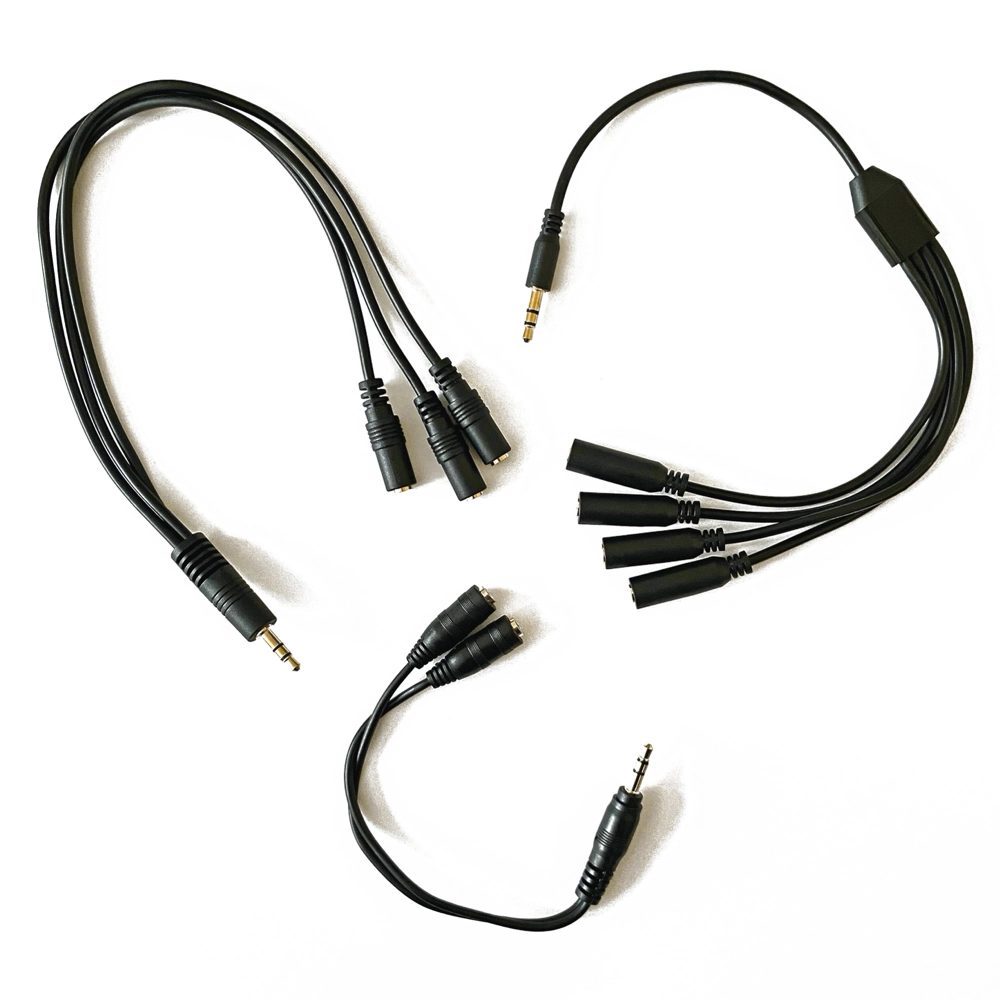
- Audio outputs: LINE (to connect 1 to 4 headphones such as this one, this one, that or that + a splitter, or an external amplifier) or SPK 3 W (amplified, 3 W into 4 ohms), selected with a switch.
- Volume: potentiometer from 0 to 100 % (digital control), with an on/off switch at the left end stop. See the "Volume" section
-
Available audio outputs:
- 3.5 mm jack
- Screw terminal
- Bluetooth (optional, a single receiver only)
-
Power consumption (measured peaks: white noise, maximum volume, 9 V supply):
- Module alone: 35 mA
- Headphones or Line output: + 5 mA
- USB stick: + 45 mA
- Bluetooth connected: + 100 mA
- 3 W speaker (4 Ω): + 400 mA
- Several modules with speakers on one power supply: 0.5 A per module
- Recommended power supply: 9 V, 1 A (DC power supply)
- Dimensions: 78 mm × 55 mm (potentiometer and jack excluded), 20 mm thick. Drilling details: see the last image.
- Sensitive to humidity and rain: for indoor use, or protected.
- Handmade by me.
Included
- Ambi'Son module (chosen version)
- Preloaded program (simple use)
- A wooden protection kit (if the option is chosen)
Not included
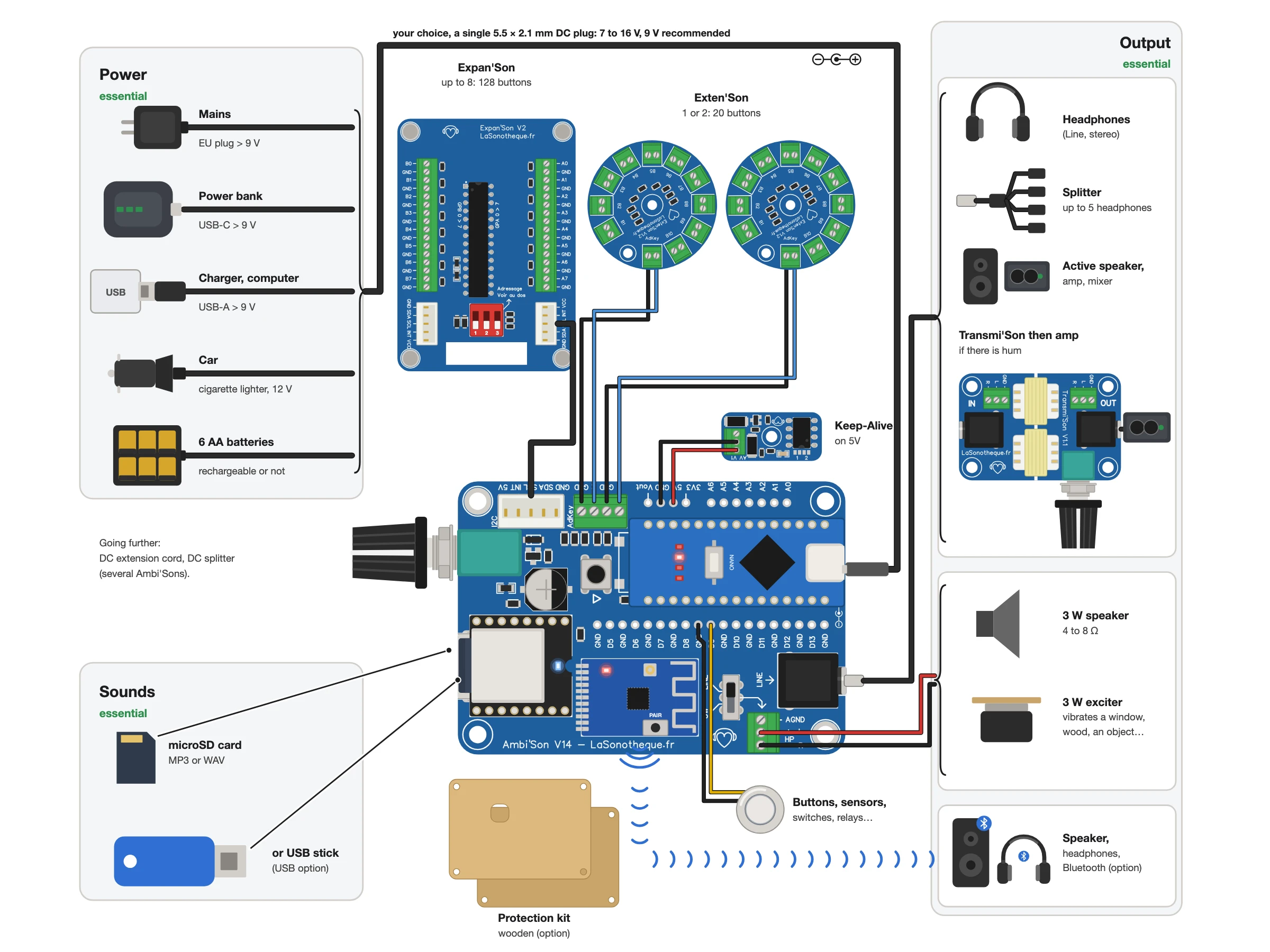
Essential to get started:
- microSD card (or USB stick), to store your sounds
- DC power supply, to power it from the mains or a power bank
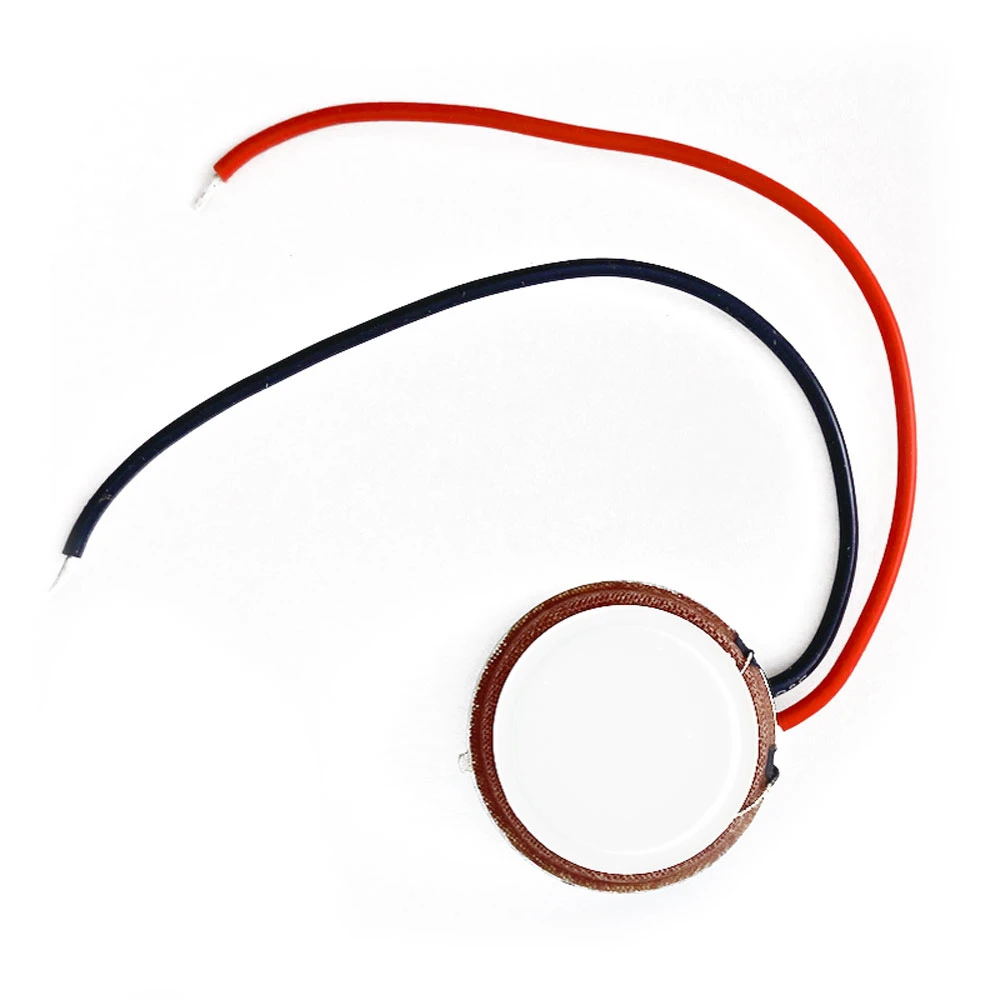
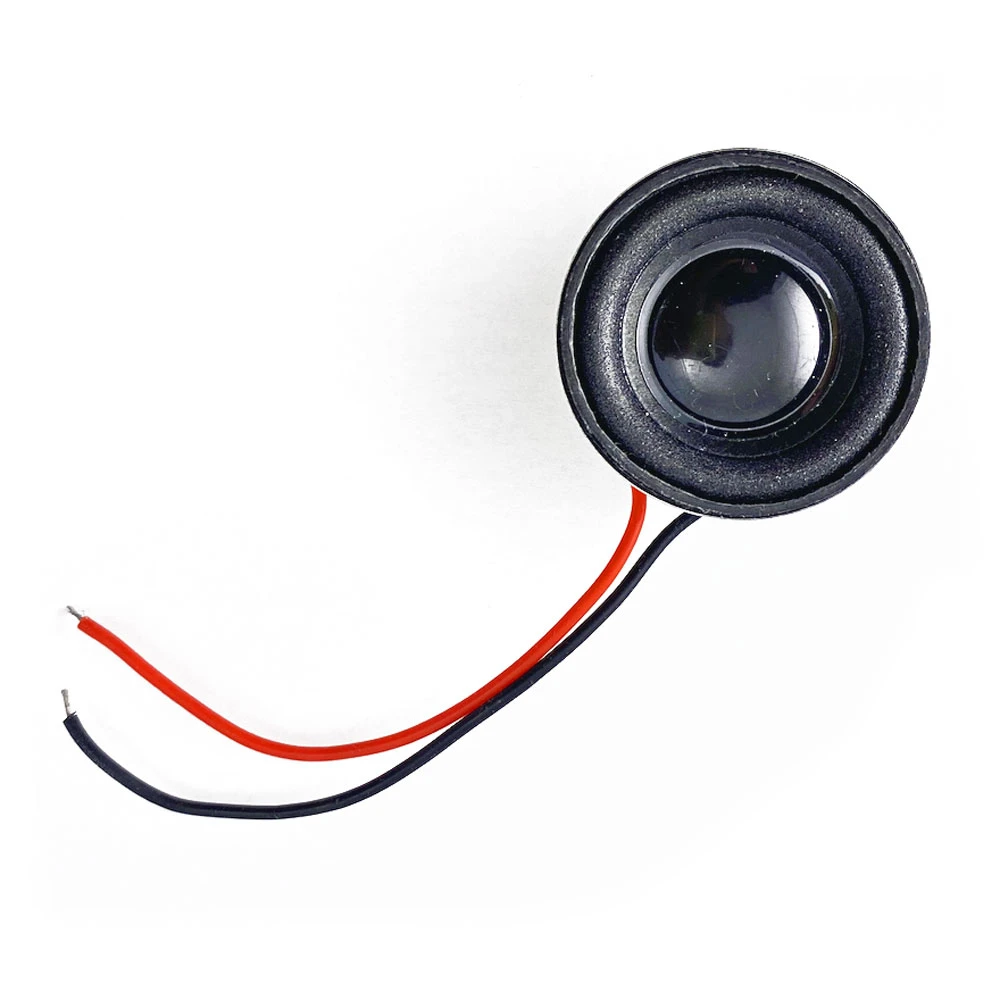
- Something to listen with: 3 W speaker or resonator, headphones, active speaker or amplifier
Depending on your project:
- Push buttons, to trigger your sounds
- Exten'Son, to easily add buttons, on the AdKey inputs
- Expan'Son, to add 16 inputs/outputs per board via the I2C bus, up to 128 when chained: buttons with the supplied program, LEDs or relays by programming the Nano
- Jack splitter, to connect up to 4 headphones
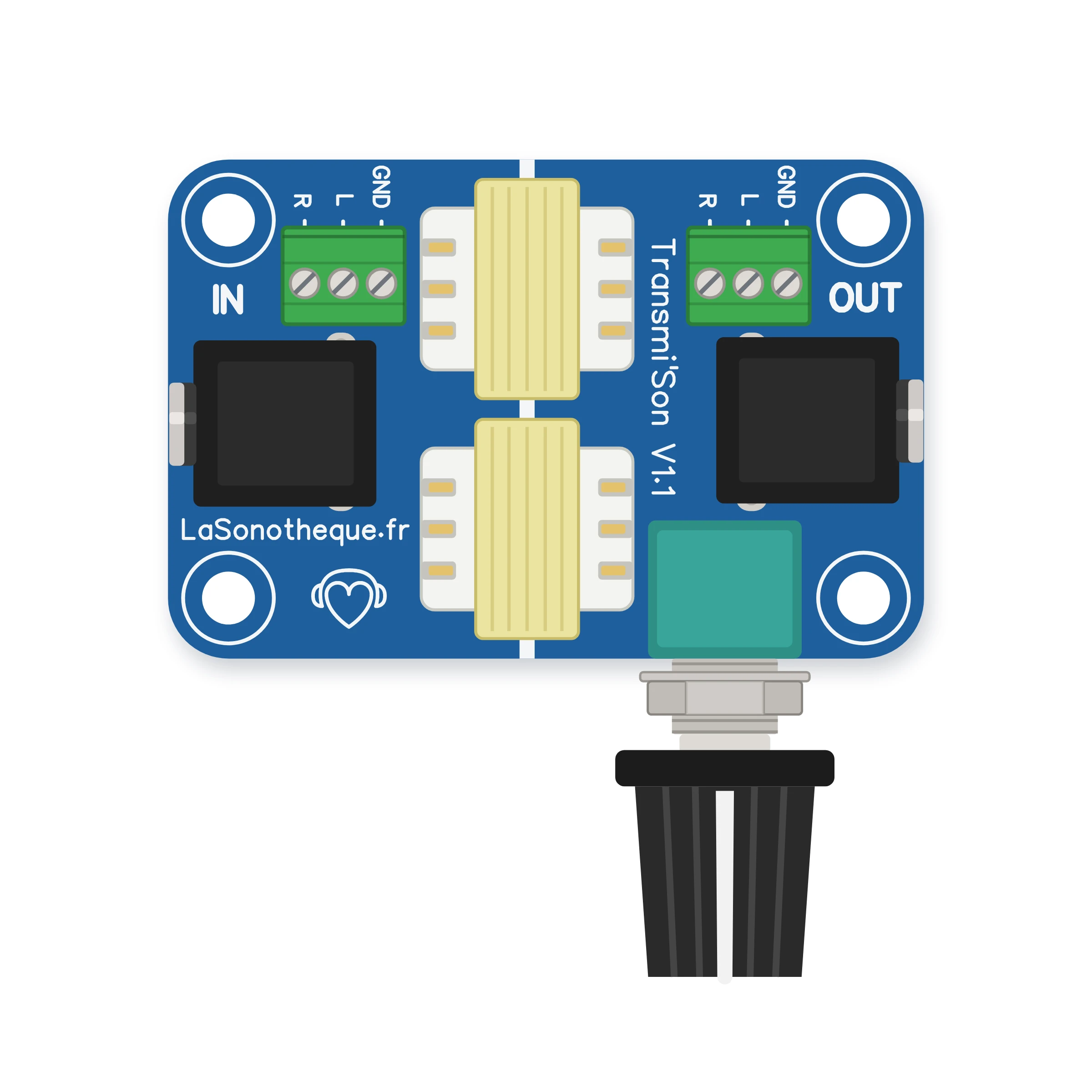
- Transmi'Son, to connect an external amplifier without hum when it shares the module's power supply, and/or to control its volume
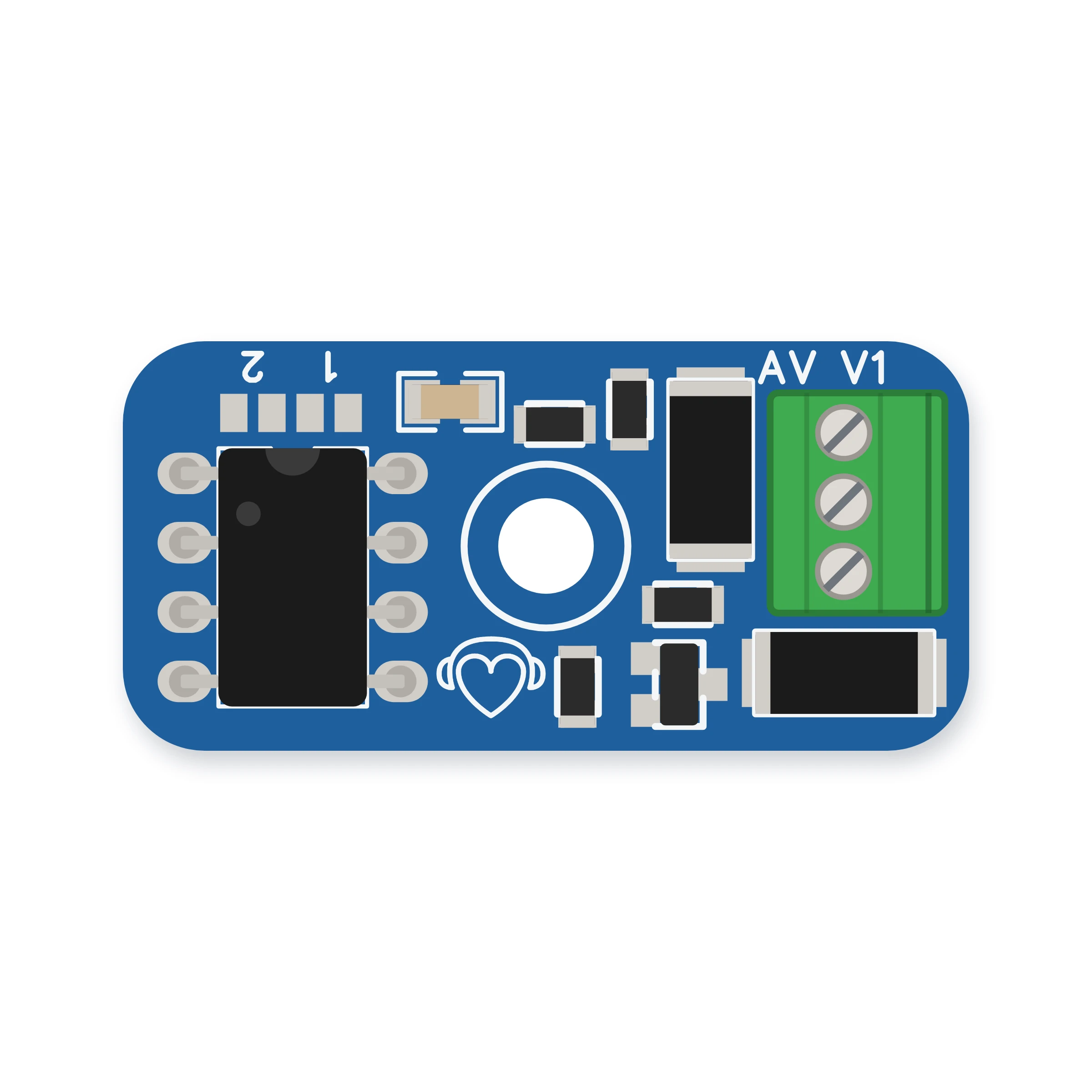
- Keep-alive, to stop a power bank from going into standby
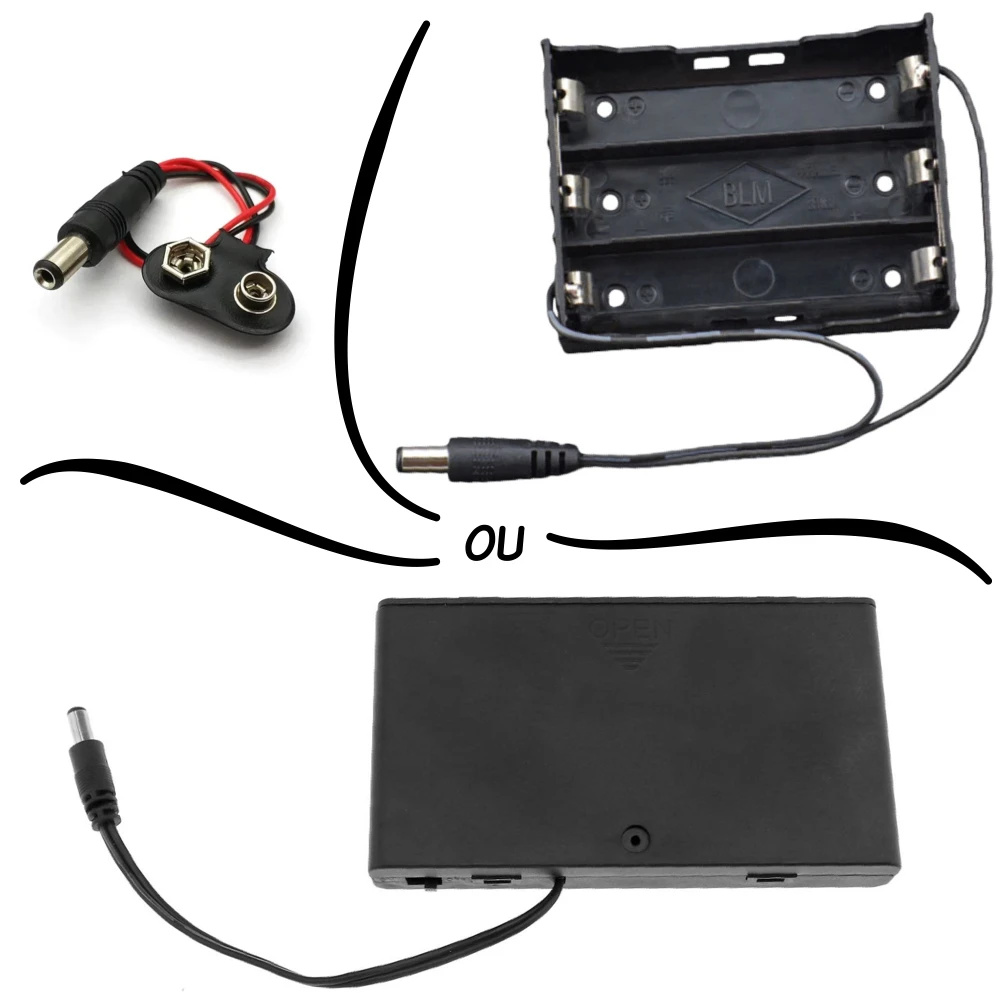
- Battery box, to power it with batteries or rechargeable cells
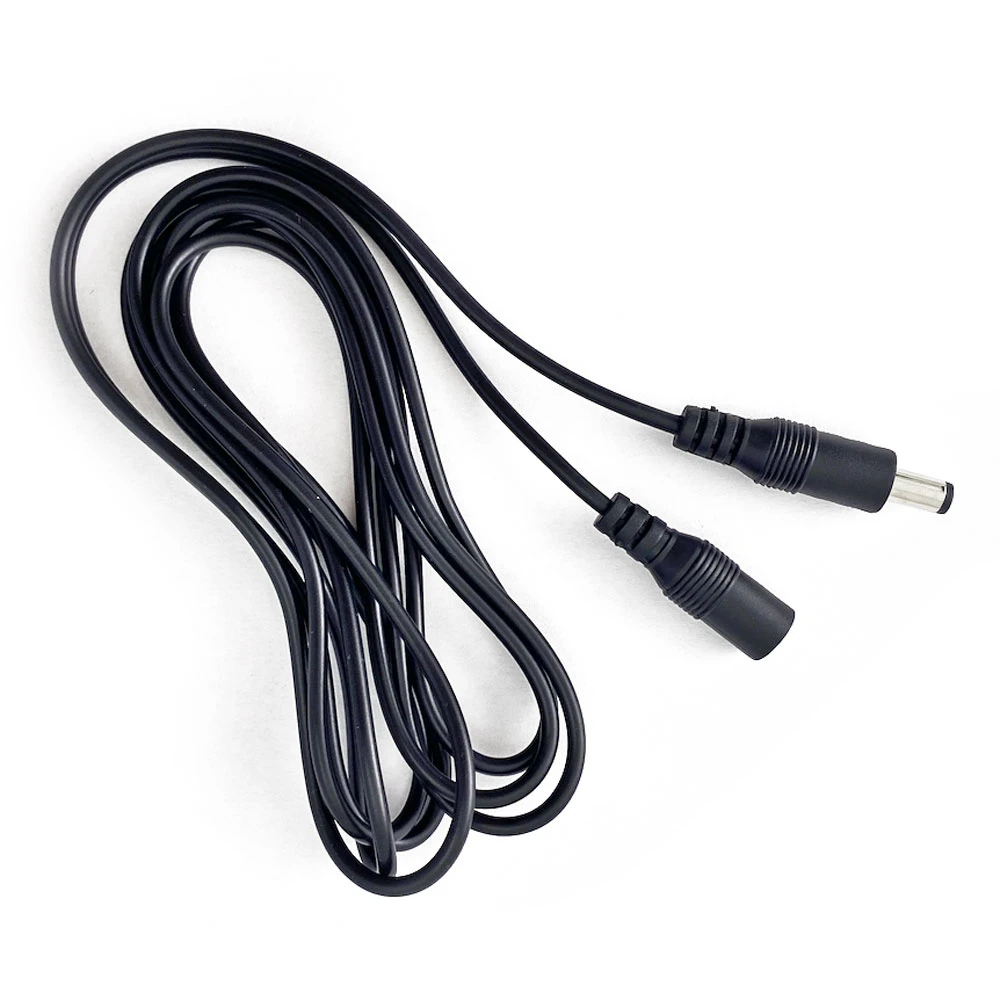
- DC extension cable, to move the power supply away from the module
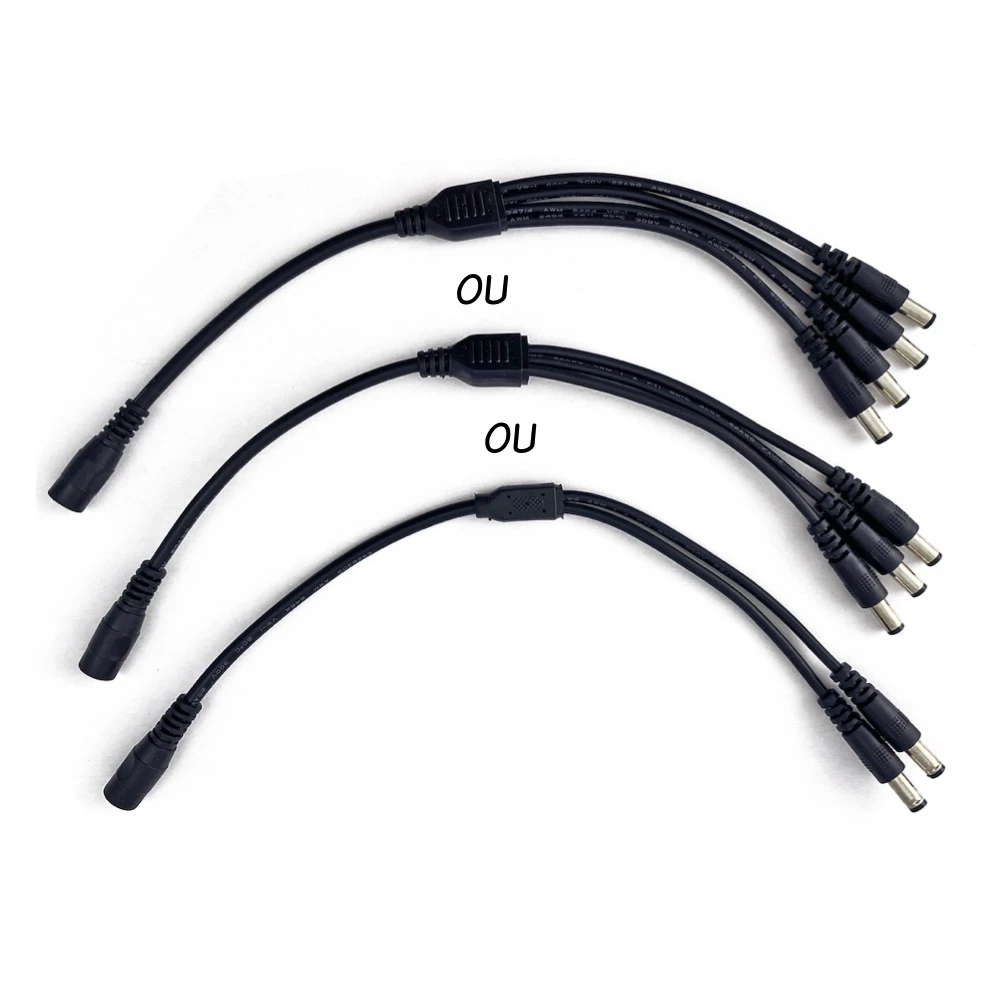
- DC power splitter, to connect several modules to a single power supply
- Closed enclosure, to protect the module
Photos, videos, components, colors, version, etc.: non-contractual.
Standards and recycling
Frequently asked questions
Can each sound be triggered by a button?
Yes. On top of the play button on the Standard version, the AdKey version lets you easily add buttons using one or two Exten'Son boards, up to 20. To go further, the I2C option takes 1 to 8 Expan'Son boards, for up to 128 buttons. In an exhibition or museum, you can wire several buttons, each triggering a sound (for example into headphones).
Which files and storage does it support?
The Ambi'Son plays MP3 and WAV files, from a microSD card or a USB key depending on the version. Put them in a folder called "mp3" and name them 0001.mp3, 0002.mp3, and so on: each sound is called by its name, whatever order you copied them in. The card or key is sold separately.
Does it need a protective case?
The board is sold bare. A case is strongly recommended to avoid any short circuit from contact with a conductive part. An optional laser-cut wooden protection kit, to assemble yourself, is available.
Do I need to know how to program?
No. My program is preloaded for simple use: looped playback, random or in order, and one sound per button. Programming the Nano (Arduino IDE, via USB-C) is only needed to go further, for example to control lights or relays.
Can a visitor turn the sound off?
Turned fully to the left, until it clicks, the potentiometer switches the module off: this switch is electrical, so the program cannot remove it. However, on request, I can fit a potentiometer without a switch. The volume itself is set digitally: I can also modify the program to raise the minimum volume to 10 or 20 %. With both changes, the unit always stays audible.
Can a museum or public body order several?
Yes. I provide quotes and invoices on request, with submission through Chorus Pro for French public bodies, and payment by bank transfer. As each module is made by hand, write to me to agree on the lead time for your quantity.
Ratings
- Rated 9.6/10 (average) - 5 Reviews
Comments
Be the first to give an opinion!
Rate & Comment
Other interesting articles
 Best seller
From 25,00 €
In stock
From 225,00 €
In stock
From 50,00 €
In stock
From 250,00 €
In stock
20,00 €
In stock
From 12,00 €
In stock
 Best seller Staff pick
15,00 €
In stock
25,00 €
In stock
From 10,00 €
In stock
From 5,00 €
In stock

45,00 €
In stock
12,00 €
In stock
350,00 €
Out of stock
From 30,00 €
Out of stock
Accessories
 Best seller
From 12,00 €
In stock
 Best seller
15,00 €
In stock
 Best seller
12,00 €
In stock
From 9,00 €
In stock
5,90 €
In stock
From 7,00 €
In stock
From 5,50 €
In stock
18,00 €
In stock
8,00 €
In stock
5,00 €
In stock
15,00 €
In stock
From 5,00 €
In stock
10,00 €
In stock
From 5,50 €
In stock
From 5,00 €
In stock
From 10,00 €
In stock
10,00 €
In stock