
The "Télé'Son U43" is an old telephone of the "So.co.tel U43" type (made of Bakelite by Ericsson from 1943 onwards). The U43 only ever existed with a rotary dial. Fitted with an audio player of my own design, it is ideal for creating a sound installation. Find it here, in the shop.
Want to fit out your own telephone? The kit has its own manual: Télé'Son U43 kit.
Quick overview
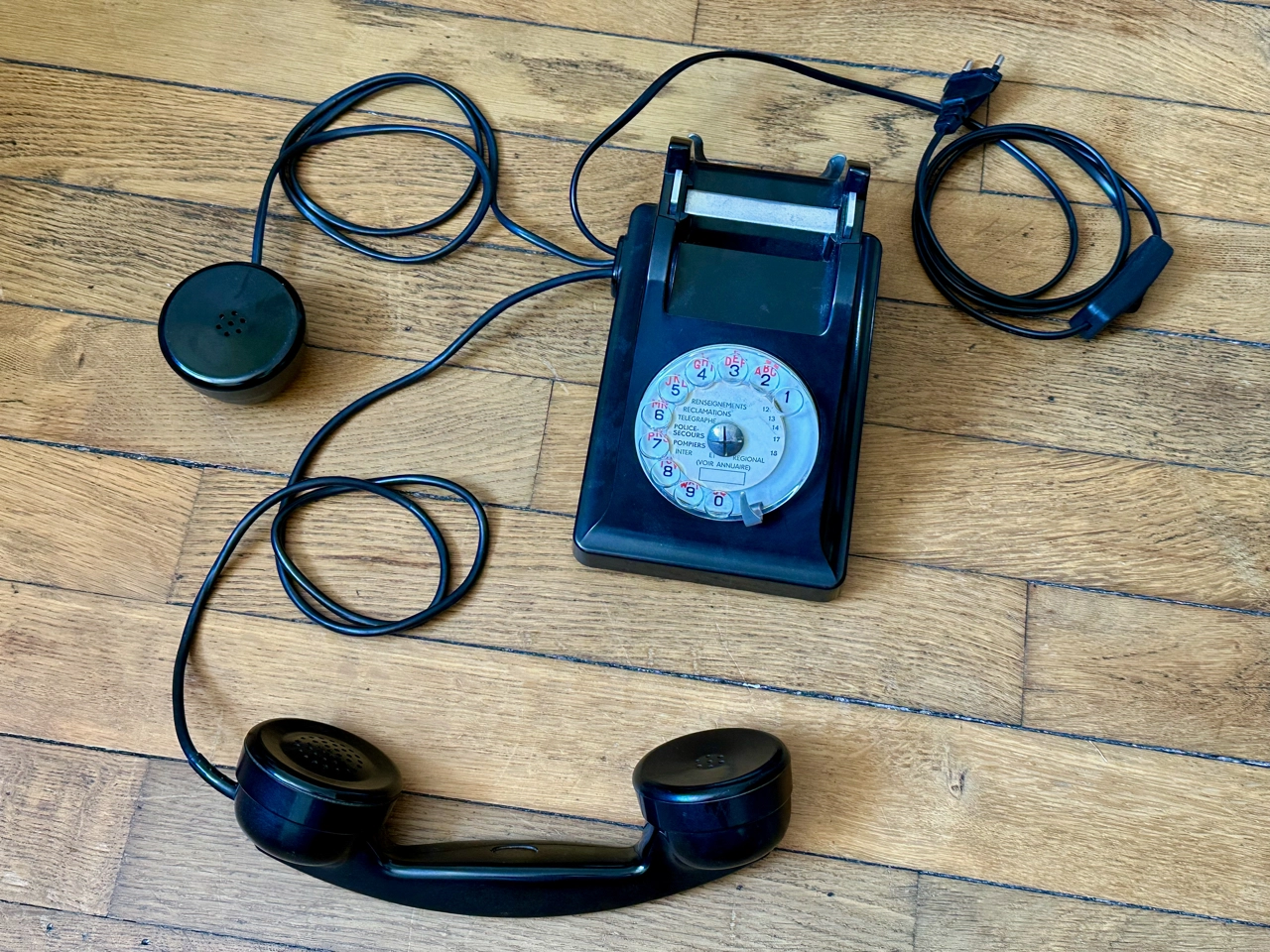
This telephone is fitted with an audio file player, with the files stored on a microSD card (included). It plays the MP3 (recommended) and WAV (up to 48 kHz / 16 bits) files on the card as soon as the handset is picked up or the dial is turned.
Models are regularly for sale in the BigSoundBank shop. If none is available, contact me: I have some in stock, and I can even fit out your own telephones to order.
Every model is unique: various colours, with or without a second earpiece, wall-mounted or desk, etc. My telephones are generally in good condition. However, they are of course VERY old devices that have come through the years. So they show signs of wear: faded colours, scratches, marks and other traces of use.
I fitted out these telephones myself. Research and development, circuit board design, right down to soldering the components: they are made by my own hands.
Fitted with an Arduino "Nano" type microcontroller, it can be reprogrammed by the more hands-on among you, to make it do whatever you like. Here are a few examples of what it can do:
- A "Quiz'O'Phone" with a single question or several questions, Christmas special.
- An escape game prop.
- An old, poetic hotel telephone.
- A "choose your own adventure" story, using the dialled numbers.
- Etc.
If you are hands-on and want to build your own installation from A to Z, follow this tutorial (cheap and easy), buy my "Ambi'Son" module or follow this other tutorial (harder but more complete). And if you want to build it yourself but get stuck, or would rather have some guidance, I can open my workshop to you to help.
Technical specifications
- Audio formats: MP3 (recommended), WAV — up to 48 kHz / 16 bits
- Storage: microSD card up to 32 GB (included)
- Power supply: mains, from 110 to 230 V, through the original cord and its switch; or from 7 to 12 V through a DC socket on the board, but then without the bell
- Power consumption: less than 5 W (typically 3 W in normal use)
- Audio outputs: handset and earpiece (3 W amplified output, mono), "LINE" 3.5 mm jack socket (stereo)
- Microcontroller: Arduino "Nano" (or clone), reprogrammable
Warning
Caution: on mains power, part of the board carries 230 V, as does the bell if you connect one. Always unplug the telephone before opening it, and never touch the board while it is plugged in. The Télé'Son is for indoor use, away from damp.
In detail
The numbers follow the path of the sound, from the power supply to the bell; the same number refers to the same part in every image on this page.
Outside
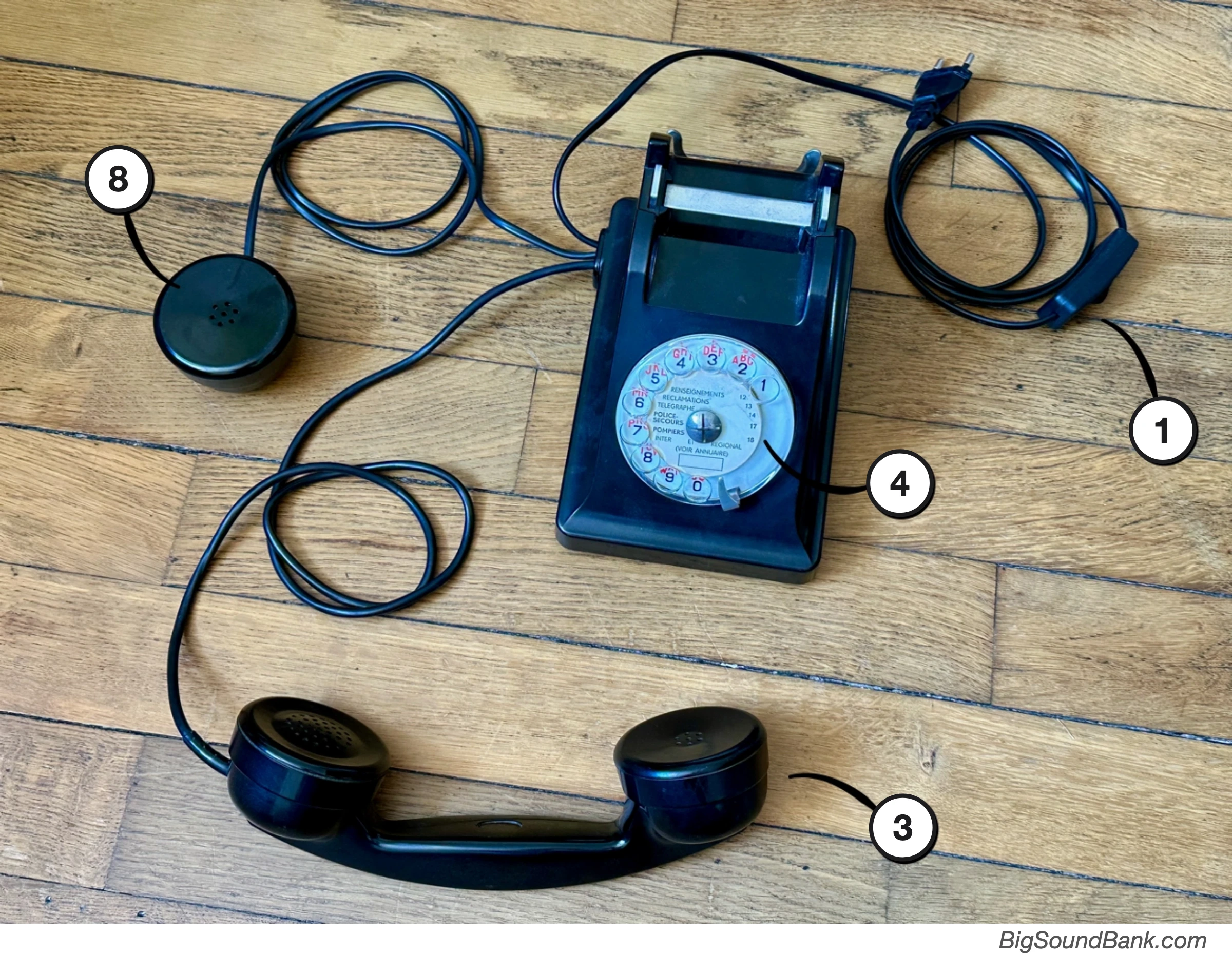
Legend
- 1: mains cord, with its switch.
- 3: handset.
- 4: rotary dial.
- 8: extra earpiece, depending on the model.
Explanations
Once the cord 1 is plugged into the mains and its switch set to ON, the handset 3 can be picked up. It plays a file from its microSD card. To move on to the next one, you can turn the dial 4.
Opening
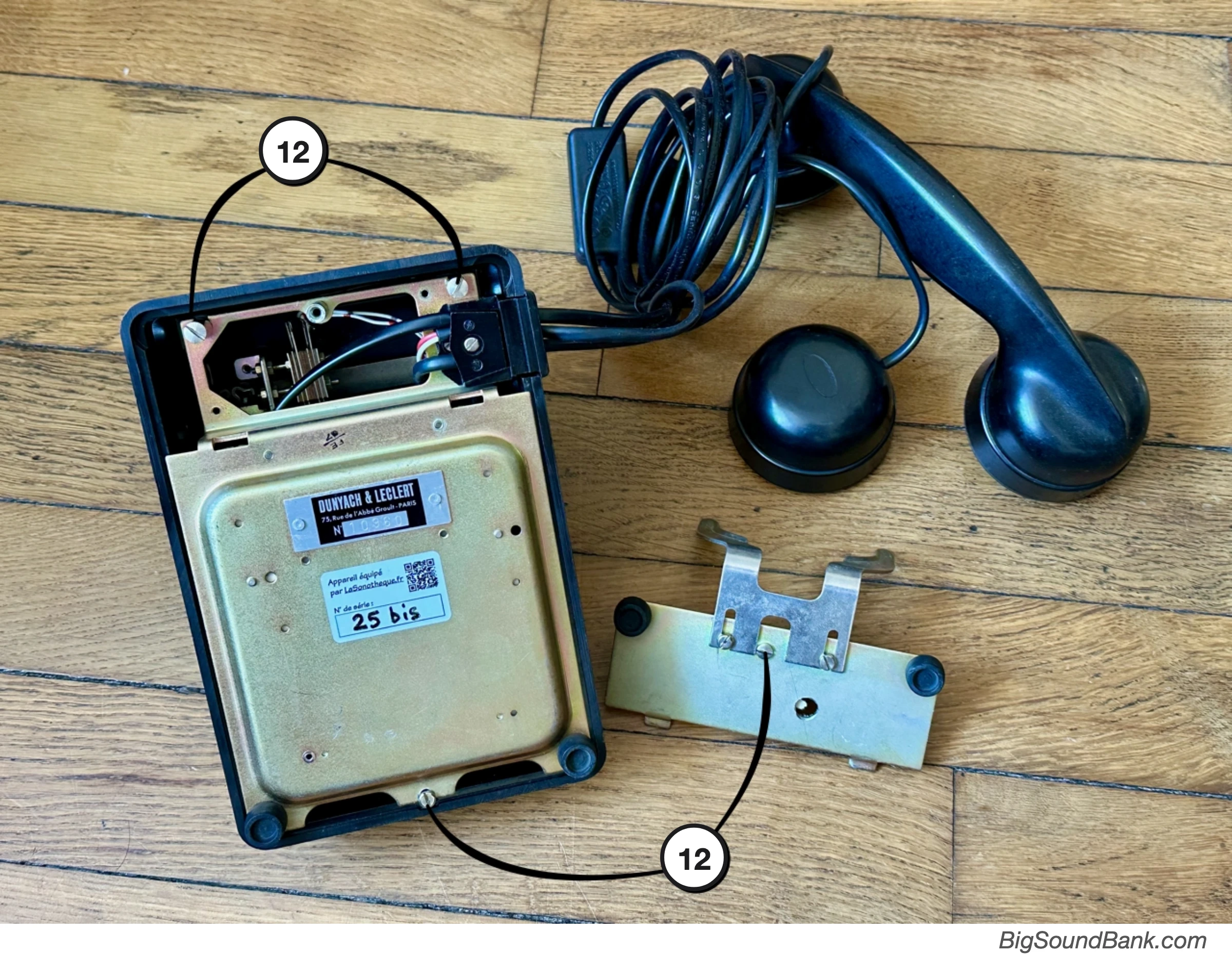
Legend
- 12: the screws for opening the telephone. Unplug it from the mains first!
Explanations
After unplugging the telephone from the mains, you can undo the screws 12 and so reach the inside of the telephone to customise it.
Inside


Legend
The diagram shows the V2.1 board, the one in the latest Télé'Son U43. On an older board, as in the photo, the parts are not all in the same place, but they are the same.
- 1: power supply: mains input, "Alim" (on the mains module, which turns it into 9 V), and 7 to 12 V socket (5.5 × 2.1 mm DC plug).
- 2: microSD card reader.
- 3: "D2" screw terminal, where the original hook switch is connected.
- 4: "ROTATIF" connector, where the dial is connected.
- 6: the six setting switches.
- 7: volume.
- 8: handset and earpiece lugs.
- 9: "LINE" jack socket, for headphones or an amplifier.
- 10: bell: its relay, and the "Bell" screw terminal for connecting a bell.
Power supply
The Télé'Son plugs into the mains 1: remember to set the cord switch to ON. The board's mains module accepts 110 to 230 V.
Without mains power, the board can also be powered through its 7 to 12 V socket, with a standard DC plug (5.5 × 2.1 mm, known as "DC5521"), + in the centre: from a DC power supply, or with a battery box (rechargeable batteries recommended, or ordinary batteries). Never both at the same time: unplug the mains cord first. The bell does not work then: it needs the 230 V of the mains.
Files
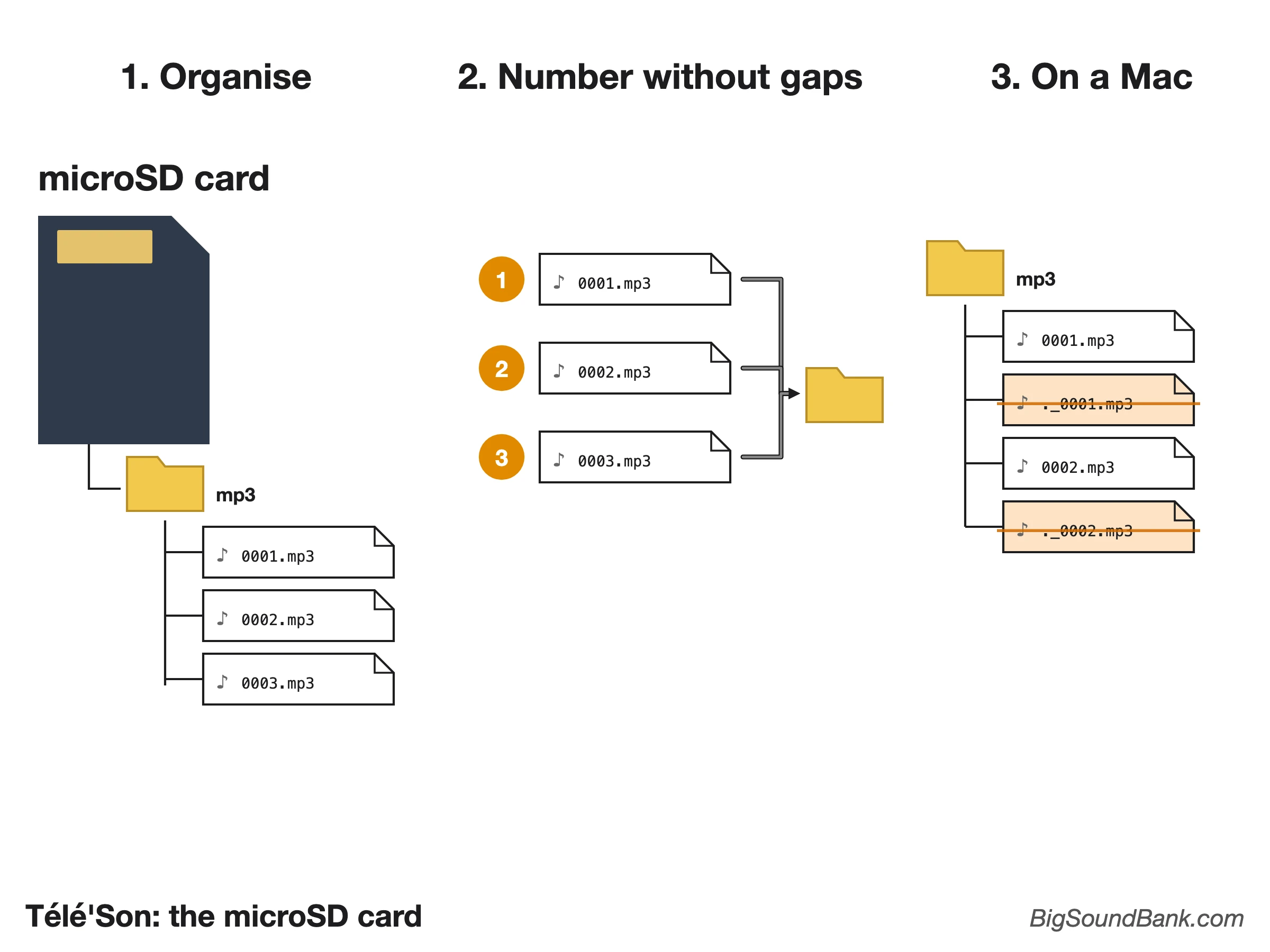
The reader 2 accepts a microSD card of up to 32 GB, formatted in FAT16 or FAT32. Put your sounds in a folder named mp3, at the root of the card, and name them 0001, 0002, 0003… without skipping a number: dialling "8" plays file 0008. The order in which you copy them does not matter, it is the name that counts. The file with the highest number is used as the intro (switch 3). Do not put anything else on the card.
On a Mac, hidden "._" files are added, which the player counts as sounds: type dot_clean /Volumes/CARD_NAME in the Terminal to delete them.
Handset and dial
The telephone knows when the handset is picked up thanks to the original hook switch, connected to the "D2" screw terminal 3. The dial is connected to the "ROTATIF" connector 4.
Some U43s, rare ones, have buttons as well as the dial. I then connect them to the board's "BOUTONS" connector: my program does not read them, they are there for your own programs (see "Nano", below).
The six switches
On the board, a red block 6 holds six small white switches. It is read from the nearest edge of the telephone: stand on that side, and switch 1 is then on the left and switch 6 on the right. Pushed up (towards the centre of the board and the markings A1 to A6), a switch is "ON"; pushed down, it is "OFF". Here is what they do:
- 1 No bell (OFF), or the bell connected to the board rings from time to time while the telephone is hung up, to attract the attention of visitors (ON, on mains power only).
- 2 Files played at random (OFF) or in order (ON).
- 3 No intro file (OFF), or back to the intro file, the last one on the card, when the handset is picked up and when a number that does not exist is dialled (ON).
- 4 Only one file is played each time the handset is picked up (OFF), or they follow one another automatically until the handset is hung up (ON).
- 5 Numbering disabled: each turn of the dial plays the next file (OFF); or enabled: if you dial 8, file 0008 is played (ON).
- 6 Rotary dial (OFF) or push-button keypad (ON): the U43 has no keys, so leave it OFF.
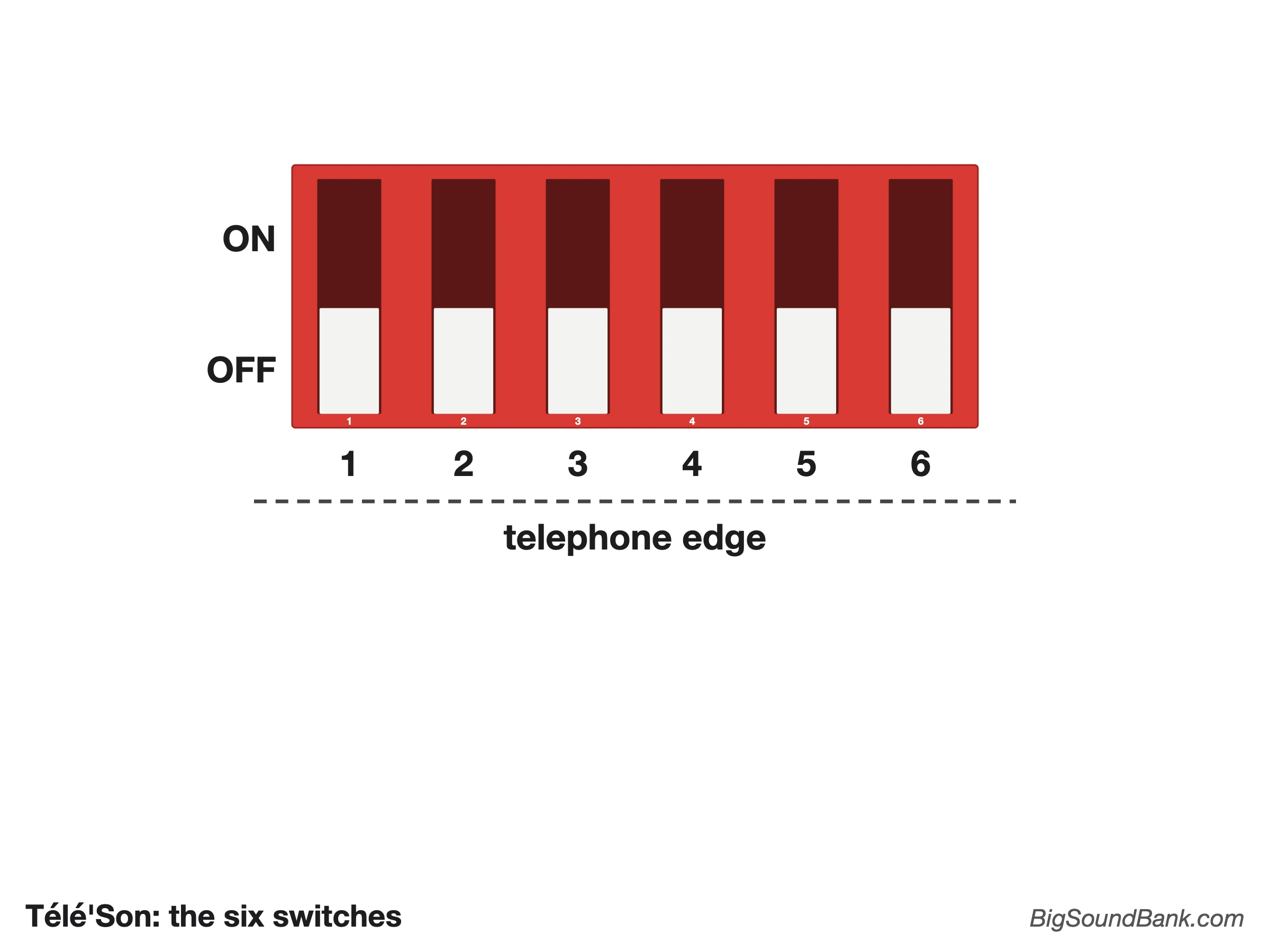
Change the settings with the telephone unplugged, then plug it back in.
Volume
The volume is set by hand, by turning the shaft of the small potentiometer 7. It acts on all the outputs.
Listening
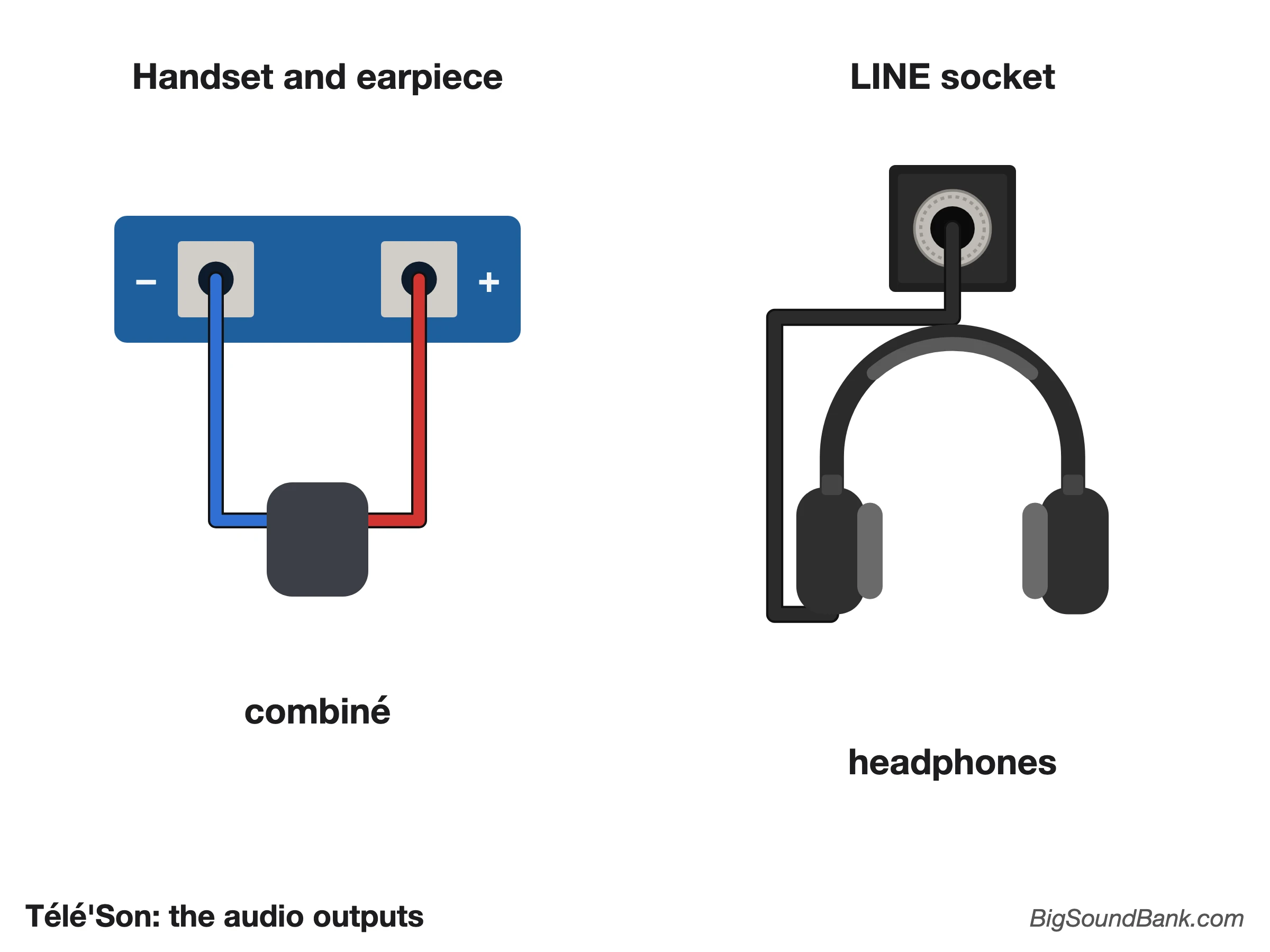
You listen through the handset (mono), whose wires are screwed onto the lugs 8. If your telephone has one, the extra earpiece is connected to the same place, and plays the same sound.
You can also plug one or more headphones (with a splitter), an active speaker or an amplifier into the "LINE" jack socket 9, in stereo. Both outputs work at the same time.
Bell
Most U43s have no original ringer. However, I have provided on the board the relay and the 230 V "Bell" screw terminal 10, to which you can connect your own bell (wiring to be done with the power off, without fail, preferably by an electrician). Switch 1 then turns it on (ON) or off (OFF). When it is ON and the telephone is hung up, the bell rings for the first time after one minute, then less and less often (at most every 5 minutes), until someone picks up.
First use
First test
- Plug the telephone into the mains 1 and set the cord switch to ON.
- Wait 5 seconds.
- Pick up the handset 3 and listen.
- Magic!
Adding your own sounds
- Unplug the telephone from the mains!
- Open the telephone with the screws 12.
- Take out the microSD card from the reader 2.
- Format it in FAT16 or FAT32 (32 GB maximum).
- Put one or more sounds into a folder named "mp3", preferably in MP3 format (or WAV, up to 48 kHz / 16 bits; you can mix both formats). Name the first one "0001", then "0002" and so on, without skipping a number.
- Put the card back into the reader 2.
- Close the telephone with the screws.
- Plug in the telephone, cord switch on ON, and wait 5 seconds.
- Pick up the handset and listen.
- Magic!
Settings (optional)
- Unplug the telephone from the mains!
- Open the telephone with the screws 12.
- Set the volume 7 as you like.
- Choose your settings with the six switches 6 (see "The six switches", above).
- Close the telephone with the screws.
- Plug in the telephone, cord switch on ON, and wait 5 seconds.
- Pick up the handset and listen.
- Magic!
If nothing happens
- Check the cord switch 1: it must be ON.
- Unplug the telephone and open it.
- Check the microSD card: pushed fully into its reader, formatted in FAT16 or FAT32, an "mp3" folder at the root, files named "0001", "0002"… without gaps, and nothing else.
- Check the volume 7.
- Close it, plug it back in, wait 5 seconds, and pick up the handset.
Have fun!
Ideas & Recommendations
- If you use numbering (switch 5 ON), dialling "8" on the dial plays the file named 0008. But the files must be numbered without gaps: if, for example, your only useful numbers are 8 and 10, you still need files 0001 to 0007, and a 0009. Silent files lasting 0 seconds will do the job, and you can generate one right here. If you use the intro (switch 3 ON), it comes after them: here, it would be file 0011.
- Out of curiosity, I measured the response of the U43 earpieces: by playing white noise (flat spectrum) and capturing what actually comes out, you can see that it behaves as a fairly narrow band-pass filter, centred on about 1–3 kHz and dropping quickly on either side — hardly any low-mids, and no treble. So there is no point putting bass or treble into it: it is wasted energy. To make up for this, the ideal is to apply the inverse curve when mixing: boost what the earpiece attenuates, but only within its useful band. In practice: keep the essentials (voices, key sounds) in the 300 Hz–3.5 kHz band, cut firmly below about 200 Hz, and push the presence around 1–3 kHz for intelligibility. Your sounds will come out clearer and louder.

Measured frequency response of the Télé'Son U43 earpieces (chart in French) - When the handset is picked up, the sound starts immediately. Slow people may therefore miss the beginning of your file. So I recommend adding 1 to 2 seconds of jingle before your file. Silence is not enough, because people who pick up quickly might think the device is not working. The jingle lets them know that the file is about to start.
- Sometimes the telephone has an extra earpiece 8. It may seem a good idea, so that two people can listen at the same time. However, you will quickly notice that some people use the earpiece without picking up the handset. Since it is the handset that starts playback, these people will hear nothing. So I recommend simply removing this earpiece.
- Even though a bell attracts visitors' attention, it quickly and seriously annoys the people around, above all the neighbouring exhibitors. So most of the time, I recommend leaving it switched off (switch 1 OFF).
- Because it is sometimes better to guard against theft, an anti-theft sling (sold separately) can be fitted: it goes through the cable exit hole and slides onto a metal rod inside the telephone. Add a simple combination or key padlock (not included). You can also extend it (sold in packs of 10).
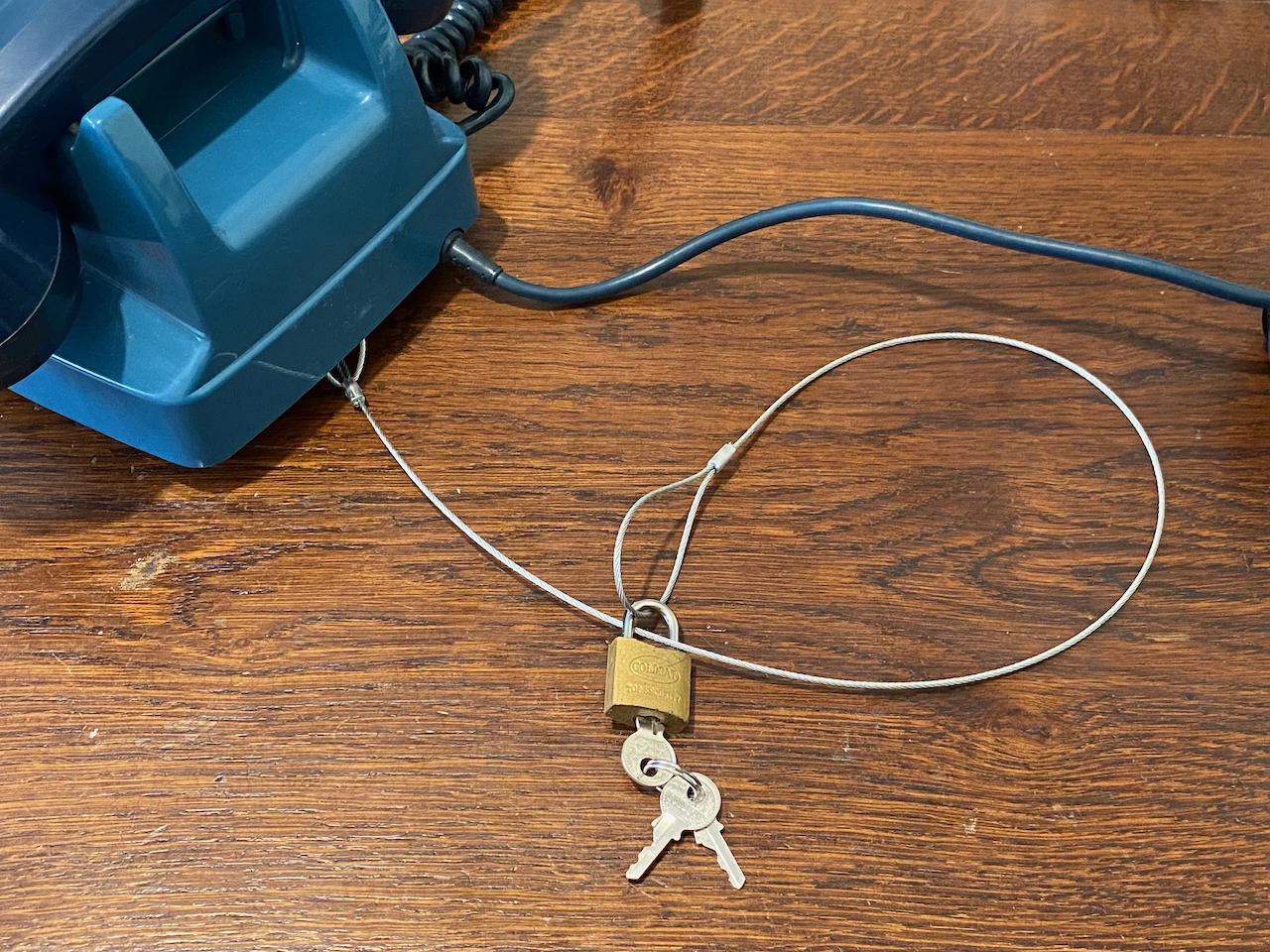
Illustration of a sling and a key padlock

Advanced use
Random explained
Although true randomness does not exist in computing, I am rather proud of mine and would like to explain it:
To prevent the (bad) luck of randomness from playing the same sound twice in a row (which is statistically possible, and frustrating), my program counts the number of files on the card, then plays them all at random, without repeating a single one until they have all been heard. Once the list is used up, it makes a new one, and so on.
Nano
The Télé'Son is controlled by a Nano. So it is perfectly possible, and easy, to create your own program. So have fun! Here are its pins, as my program uses them:
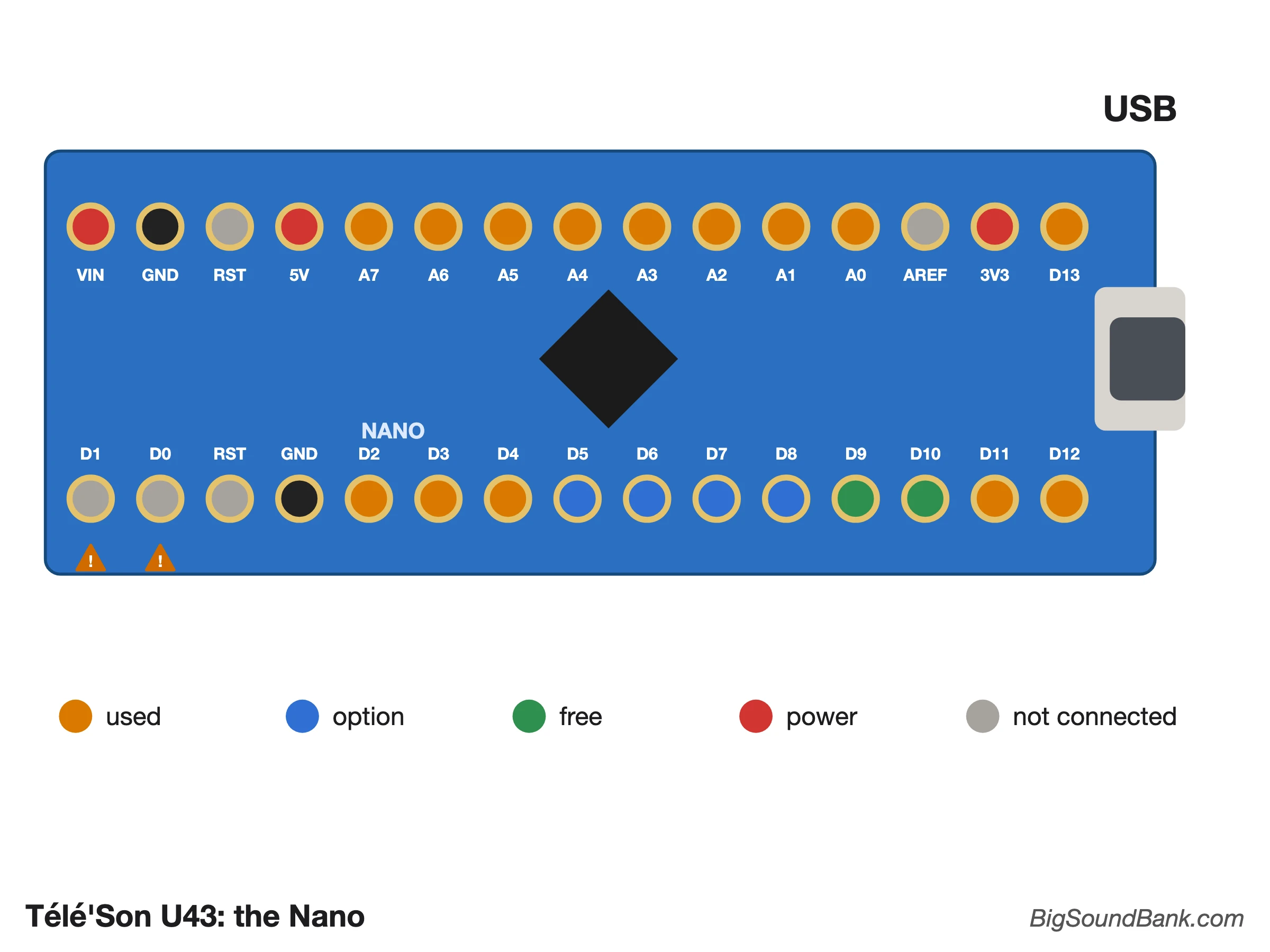
You can also get help from the DFPlayer Wiki.
Have an idea and want to know whether it can be done, and how? Feel free to contact me!
Problems & Solutions
While the DFPlayer is a brilliant little player that powers many of my creations, including this one, it has many small flaws that are nevertheless easy to work around. So here is an article dedicated to solving all the problems of the DFPlayer Mini.
Versions
Every time I launch a new production run of circuit boards, I make a few changes to the design. Feel free to send me your suggestions for the next versions.
- February 2025 - V1: First version.
- June 2025 - V2: Digital volume. Stereo output possible, on headphones or with both earpieces.
- November 2025 - V2.1: Separate "LINE" (stereo) and "3W" jack sockets, protection of the bell output. The "3W" socket has no longer been fitted since November 2026.
Conclusion
Using this Télé'Son is really simple but, at the risk of repeating myself: feel free to contact me if you have the slightest question or suggestion about it!