
When a Starling Becomes a Living Hard Drive
Published by Joseph SARDIN, on
Summary
- A YouTuber converted a bird drawing into sound using a spectral synthesizer
- The starling memorized and reproduced that sound with stunning accuracy
- The image reappeared in the spectrogram of its song
- 176 kilobytes of information transferred biologically
- A fascinating demonstration of avian vocal capabilities
Turning a living bird into a data storage device. That's exactly what Benn Jordan, a musician and acoustic researcher, accomplished with a European starling named "The Mouth". The experiment was documented in a 30-minute YouTube video that quickly circulated on social media.
The principle: converting an image into sound
Jordan was working on a birdsong analysis project when he had the idea to test whether a starling could "save" an image in its vocal memory. Starlings are renowned for their mimicry abilities, capable of precisely reproducing sounds they hear: camera shutter clicks, human voices with reverb, car horns.
Using a spectral synthesizer, Jordan drew a simplified image of a bird. This type of software transforms a visual shape into sound frequencies: each point in the drawing corresponds to a specific pitch and moment in time. The result is a sound incomprehensible to the human ear, but which, when analyzed on a spectrogram, reveals the original image.
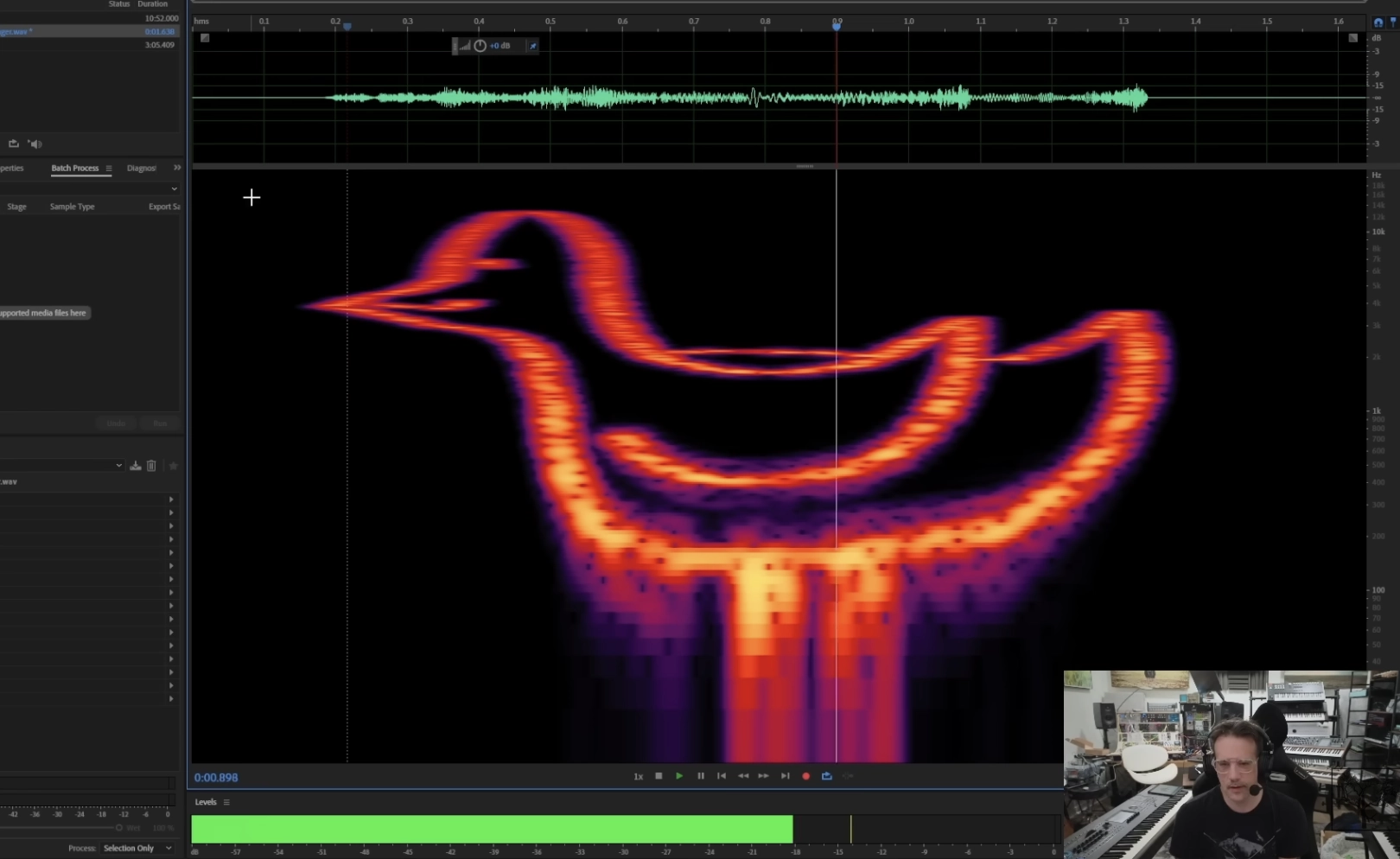
This "sound drawing" technique isn't new. Aphex Twin famously hid his face in the spectrogram of certain tracks. But no one had attempted to have a living animal reproduce this type of sound.
How the experiment unfolded
Jordan played the sound to the starling several times from his smartphone. During the recording session, the researcher didn't notice the bird reproducing the sound. As he explains in his video: "we didn't hear him clone it or sing it."
It wasn't until he got home, reviewing "several gigabytes of recordings from the session," that Jordan made the discovery. Here are his exact words: "I noticed a little bird in the spectrogram. At first I thought I was just seeing my phone playing the sound to the starling, but it was much later in my visit, and it was combined with another type of vocalization."
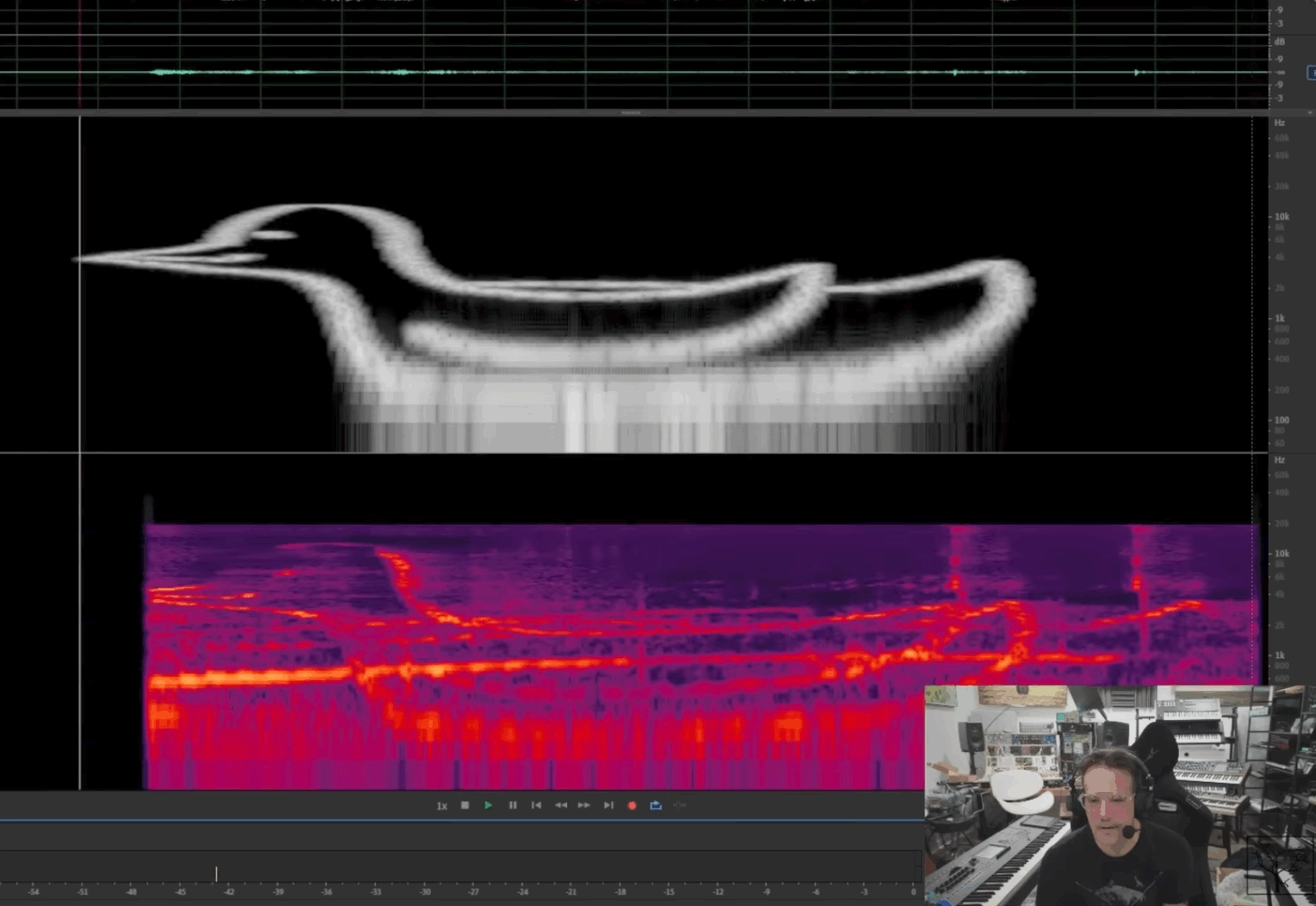
The bird had learned it instantly. According to Jordan: "I played it maybe 5 times because I really didn't expect him to pick it up unless he was regularly exposed to it and thought it was another bird living in his environment."
The results: 176 kilobytes transferred
The starling reproduced the sound in the same frequency range it had heard it. Jordan notes minimal loss of precision: "We lost a little bit of precision in the starling's song, and it was about 50 to 60 Hz lower. Musically, that literally means nothing in the 4000 Hz range."
The recreated waveform preserved its structure across the entire 4000 Hz range. Jordan estimates this performance is equivalent to transferring 176 kilobytes of uncompressed information. With a theoretical 10:1 audio compression protocol, this could represent approximately 2 megabytes per second.
The syrinx: the organ that makes it all possible
This ability relies on the syrinx, the vocal organ of birds. Unlike the human larynx which functions with a single air passage, the syrinx divides into two tubes like an inverted Y. Birds can independently modulate the airflow in each half, thus producing two sounds simultaneously.
Starlings have several pairs of muscles controlling this organ. This structure allows them to achieve what Jordan describes as a "biological equivalent of two-channel FM synthesis," capable of replicating not only pitch and rhythm, but also reverb and envelope characteristics of synthetic and mechanical sounds.
High-resolution equipment
Jordan used Sonorous S04 ultrasonic stereo microphones and a Zoom F3 field recorder, capable of recording at 192 kHz in 32-bit. This high resolution allows slowing down recordings without loss of quality, revealing modulated layers far beyond human auditory perception.
As Jordan explains, this high temporal resolution is important because "seconds last much longer for a starling." Any imperfection becomes much more noticeable in what could be called "bird time."
A bird with a unique background
"The Mouth" had been found abandoned by the roadside as a baby, likely stressed by the proximity of a railroad. Young songbirds learn their songs through imitation. Deprived of this generational transmission, this starling represented a "blank canvas" for the experiment.
Sarah Tidwell, an artist and animal rescuer, cared for this bird. Raised by humans, "The Mouth" proved particularly receptive to reproducing unusual waveforms compared to wild starlings.
Acknowledged limitations
Jordan himself acknowledges that this data storage method remains purely experimental. He notes there are "a lot of caveats and limitations," and that birds make unreliable data transmission vectors, with too many unpredictable variables for practical binary storage.
Nevertheless, as he points out: "The fact that you could set up a speaker in your yard and potentially store any amount of data in songbirds is insane."
Exceptional vocal abilities
This experiment fits into a broader context of research on starling capabilities. These birds live in groups that can number several thousand individuals and are known for their murmurations, those synchronized aerial ballets. Their vocal repertoire includes whistles, crackles, and clicks.
According to Rod Sayler, a wildlife ecologist at Washington State University: "Starlings are accomplished mimics. They pick up sounds from other starlings and songbirds, but also from people and inanimate objects." He adds that how starlings integrate such an elaborate repertoire into their vocal behavior is the subject of extensive research, "with no single answer."
Spectral analysis as a study tool
The experiment highlights the usefulness of spectral analysis for studying animal communication. Spectrograms allow "reading" sounds visually, revealing subtleties impossible to detect by ear. Apps like SpectrumView for iOS or SpectralPro Analyzer for Android make this technology accessible.
Jordan also mentions other tools: Birdnet and Merlin Bird ID, artificial intelligence programs for identifying birds by their songs.
A viral reaction

The video quickly circulated on social media. Sterling Crispin shared the experiment in a widely circulated tweet: "This is one of the wildest ideas I've ever seen. He converted a drawing of a bird into a spectrogram (PNG to sound wave), then played it to a starling which sang it back reproducing the PNG. Using the bird's brain as a hard drive with 2 Mb/s read-write speed."
The experiment demonstrates that nature has information transmission and memorization systems of remarkable complexity. A 70-gram starling can memorize and reproduce hundreds of different sounds, adapting its repertoire based on its environment.
And you, would you be willing to entrust your personal data to a starling rather than to the cloud? What do you think?
"Any news, information to share or writing talents? Contact me!"
- Joseph SARDIN - Founder of BigSoundBank.com - About - Contact