

The Lego Smart Play Brick, in Sync with Sound Rhythm
Published by Joseph SARDIN, on
Summary
- A smart 2x4 brick at the heart of SMART Play.
- Motion, color, tag, and minifigure sensors.
- Real-time generated sound, like a mini synth.
- Effects modulated by gestures and context.
- The first sets launch on March 1, 2026.
Many LEGO fans come to La Sonothèque looking for sounds when they make stop-motion videos: they need engines, footsteps, impacts, ambiences, basically anything that brings life to silent bricks. Today, LEGO is releasing something new that puts sound at the center of play: let’s take a look at “Smart Play.”

A brick that finally responds
Picture a Sunday morning coffee table. LEGO pieces scattered around, a half-built spaceship, and that little hesitation when playtime starts: okay, we built something… but how do you bring it to life, with no screen, no app, no “press here” that cuts imagination off?
That’s exactly where the SMART Brick (the central brick in the LEGO Smart Play system) fits in. It has the familiar 2x4 format, but inside it packs an electronic brain and sensors that turn what a child does into immediate reactions: light, behaviors… and most of all, sound.
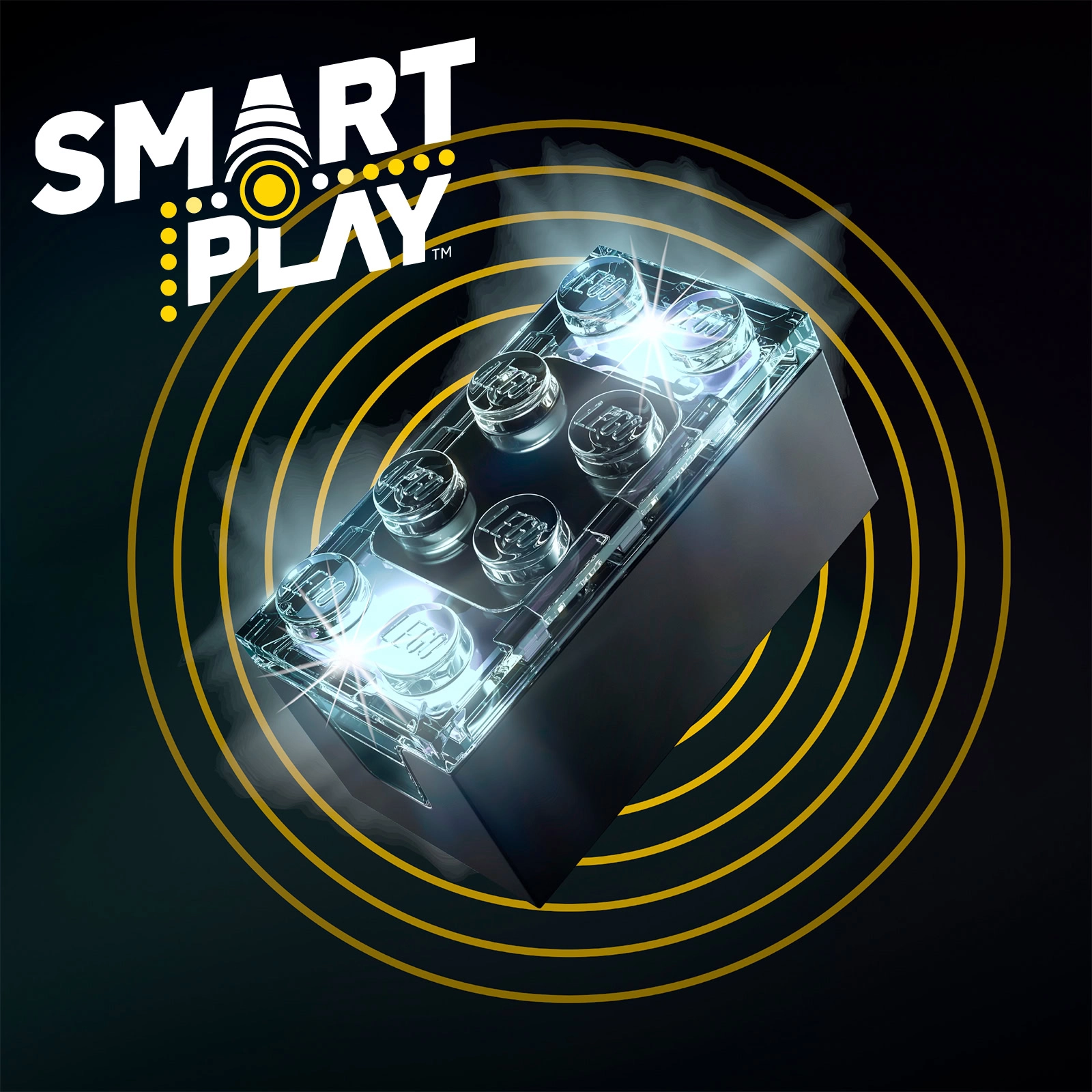
What the Smart Play brick includes
- Reader (NFC-like) for compatible Smart Tags and Smart Minifigures
- LEDs for visual feedback
- Built-in speaker (amplified through the brick’s cavity)
- Motion sensors (acceleration, tilt, impacts)
- Sound capture for interactions triggered by the environment
- Color sensor
- BrickNet connectivity (brick-to-brick communication)
- Onboard processor and game software
How Smart Play works
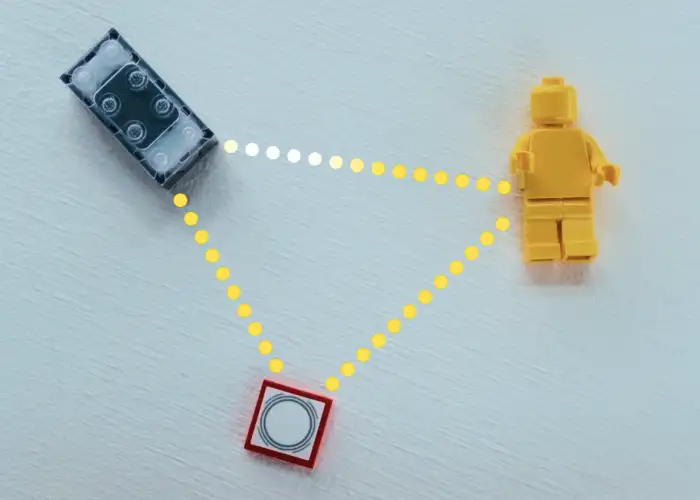
Smart Play relies on a trio: the SMART Brick, SMART Tags (tiles that give an object an “identity”), and SMART Minifigures (characters that trigger specific reactions). In practice, the brick detects these elements and understands what you’re staging. The same build can “become” a vehicle, a creature, or a setting depending on the tags and minifigure you use.
The SMART Brick is also sensitive to how you handle it: movements, tilts, impacts, rotations. It also “sees” its environment thanks to a color sensor, which makes it easy to imagine interactions with almost any existing LEGO world.
And when multiple SMART Bricks enter the game, they can communicate with each other via a mesh network (BrickNet). The idea is simple: builds are no longer isolated islands. They can spot each other, respond to each other, and coordinate effects, without a screen acting as the conductor.
On the power side, the promise is clearly designed for real play: a built-in battery and wireless charging avoid the classic “you have to take everything apart to change batteries” scenario. And even if the experience is built to work screen-free during play, software updates are planned.
Sound, the beating heart of the SMART Brick
You could sum up Smart Play sound as “sound effects.” That would miss the point: LEGO isn’t just adding noise, it’s building a sonic language that follows the action, like living foley.
First key point: the sound is produced in real time. In other words, the SMART Brick isn’t just a box that replays pre-made tracks. It relies on a game engine and a form of sound synthesis to generate textures, then transform them based on context. LEGO talks about a “synthetic soundscape”: a few base sounds, reduced to their core principles, whose frequency and amplitude can be adjusted to yield radically different results. That’s where the magic gets concrete: the same brick can roar like a jet engine… or imitate a toilet flush, without swapping “libraries” for every new theme.
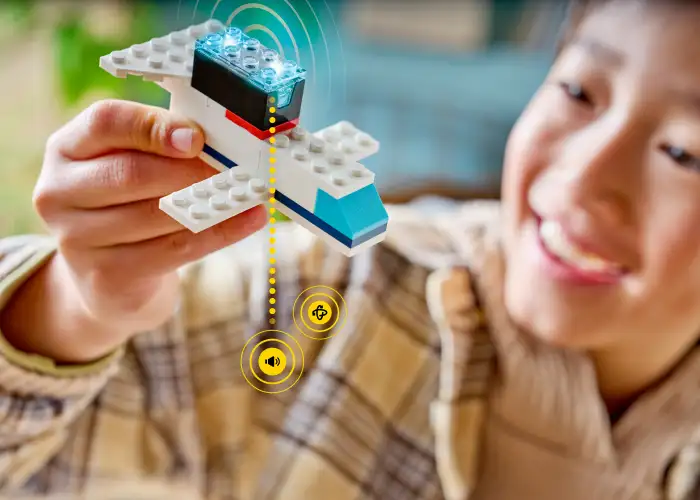
Second point: the speaker isn’t an afterthought. The brick uses its internal volumes to amplify sound, as if the plastic’s air cavity became a tiny resonance chamber. Expected result: an immediate, tactile response that sticks to the gesture. You make your ship take off? The engine ramps in. You flip it or shake it? The reaction changes, because the brick reads acceleration, orientation, the physical intent of play.
Third point: sound is contextual, and therefore narrative. SMART Tags tell the brick “who I am” (an X-Wing, a turret, a throne, a droid…), and SMART Minifigures add a personality layer: moods, reactions, sonic signatures. It’s no longer just a ship that goes vroom. It’s a scene that starts to breathe. A character entrance can trigger a musical theme, a duel can install a continuous hum, an action can create a sonic punctuation mark.
Fourth point, often underestimated: the brick also listens, literally. A sound sensor (and, based on the information shared, a mic intended for interactivity) can trigger reactions to gestures like blowing or clapping. It’s a small detail, but it changes everything: sound is no longer only the consequence of movement, it becomes a dialogue. Sometimes the piece hears you, and it answers.
And from a foley perspective, it’s a fascinating playground. Smart Play brings to kid scale ideas you see in interactive audio: parametric sound, endless variation, continuity between action and sonic output, transitions instead of hard one-shot triggers. The toy gets closer to an instrument: you don’t launch a sound, you drive it.
Features designed to tell stories, not distract
Launching with Star Wars sets isn’t random: the universe is instantly readable, so it’s perfect for understanding the “sound + gesture” effect. The first announced kits highlight engines, blaster shots, repair sounds, lightsaber hums, and even a musical theme triggered by staging. The goal isn’t to replace imagination, but to give it a play partner.
What remains to be seen, once families actually have the sets in hand, is how refined the sonic behaviors are day to day: volume management in a room, sound clarity amid general noise, listening fatigue, and the balance between the “wow” effect and the space left for silence. Because the best foley sometimes is the one that knows when to stop.
So how do we play now?
If Smart Play delivers on its promises, the SMART Brick could become a new LEGO play grammar: you would build objects, yes, but above all you’d build behaviors. And sound would be the invisible thread linking gesture to story, like a breath living inside the build.
So what would you want to hear coming out of a simple brick?
"Any news, information to share or writing talents? Contact me!"
♥ - Joseph SARDIN - Founder of BigSoundBank.com - About - Contact