
Audio Feedback in Movies Shreds my Ears
Published by Joseph SARDIN, on
Summary
- Feedback is a real physical phenomenon, but rare in a controlled situation.
- In movies, it mostly works as a code that means “a mic is turning on.”
- On a megaphone or a radio, that feedback is often impossible.
- There are alternative sound cues that stay clear and believable.
- Editors can serve the story without sacrificing realism.
Movie feedback, that sonic tic that stabs your ears
You know the scene. A character steps up to a lectern, taps the mic, takes a breath, opens their mouth… and then, inevitably, a long “eeeeeeeeee” tears through everyone’s eardrums. The room jumps, the hero winces, and the viewer thinks once again: really, feedback again?

This editing reflex is so ubiquitous it feels mandatory as soon as a microphone appears on screen. No matter the context, the gear, or the technical plausibility: if an actor is about to speak into a mic, feedback has almost become a supporting character.
What feedback physics actually says
Feedback, or the Larsen effect, is actually a very specific phenomenon. It occurs when a sound system creates a loop: sound comes out of a loudspeaker, goes back into a microphone, is re-amplified, comes out of the loudspeaker again, and so on until it produces that famous continuous howl. For that to happen, you need enough gain, a particular arrangement between mic and speaker, and an environment that favors this acoustic loop.
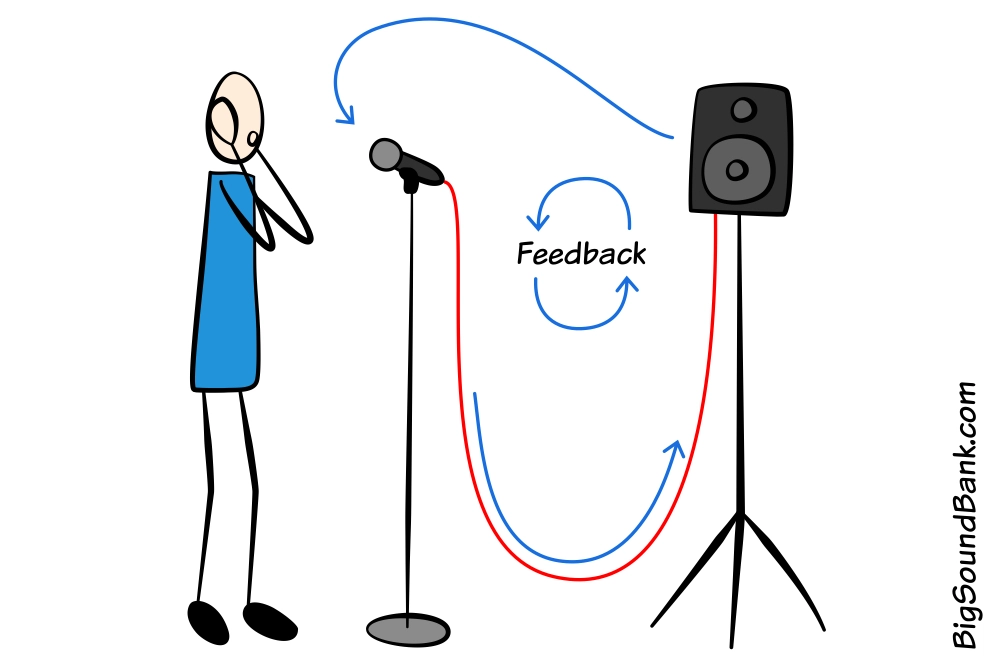
The distance between mic and loudspeaker, the orientation of each, the directivity of the gear, the room acoustics, and how the levels are set all play a huge role. In a well-configured sound system, you do everything you can to push that breaking point back and avoid feedback, even if it means EQing, repositioning, or turning the volume down a bit.
In other words : in real life, a mic turning on does not automatically produce feedback. Fortunately for our ears… and for sound engineers, whose job is precisely to keep that from happening.
Why sound editors love it anyway
So why does cinema lean on it so much? Because feedback has become an ultra-readable narrative code. In a fraction of a second, it says several things at once: “a mic has just been opened,” “the situation is a bit awkward.” No need for explanations, everyone understands.
Analyses of movie tropes describe this feedback as a “demonstrative” effect: an exaggerated sound that is used less to reproduce reality than to point it out to the audience. Same principle as a ringtone that appears out of nowhere or the famous “Wilhelm scream” : credibility is sacrificed in favor of an immediate, almost caricatured sign.
From an editing point of view, it is tempting. You have a wide shot of a crowd, an important speech, a mood that feels a bit flat? Hit everyone with a good blast of feedback and all heads turn. Effective, yes. But rarely believable. At the very least, it immediately cheapens both the work of the sound engineer on set and the editor who made that ridiculous choice.
Megaphones, radios, and other cases where feedback is absurd
That is where the habit becomes outright ridiculous. Think of the classic megaphone: most of the time, the mic is built into the horn or connected by a cable at the back, pointed toward the user while the loudspeaker projects sound forward. The manufacturer has every interest in minimizing the risk of feedback, by playing on the horn’s directivity, the mic placement, and the amp’s limited power.
For a megaphone to start screaming with feedback, you generally need extreme conditions: the mic really close to the loudspeaker, the volume pushed to the maximum, strong reflections on hard surfaces, or a second sound system nearby. In most normal uses, nothing happens… apart from a loud, slightly nasal voice.
Even more absurd : the famous radio scene. A host speaks into a studio microphone, headphones on, the voice going out to the listeners, not to a speaker sitting right next to them. There is simply no mic/speaker loop in the room. And yet we sometimes hear a very “live sound system” type feedback, as if an invisible loudspeaker had just started screaming inside the studio.
Same thing with a little walkie-talkie mic or a non-amplified booth mic. If no loudspeaker is pointed at the mic and the system is not set right on the edge of disaster, feedback has no reason to exist. The movie just invents it to make us feel there is “sound” in the scene, even if it means violating the most basic laws of acoustics.
Telling the same story… without betraying the sound
The good news is that you can tell exactly the same story without overusing that unrealistic howl. To signal that a mic is being turned on, a simple switch pop, a slight hiss that appears, a change in perspective, or the room tone suddenly sticking to the voice is more than enough.
To convey a clumsy speaker, you can let their hand smack the capsule, let the mic rub against the stand, play with a little volume glitch or pumping compression. On radio, a short RF hiss, a console click, a poorly timed jingle are infinitely more coherent than a fake town-hall-PA feedback howl.
As for the megaphone, it offers a fantastic playground: loud hiss from a cheap amp, transient saturation, horn distortion, echo of the voice on building façades… All of that tells the story of the space, the gear, the situation far better than an artificial scream copy-pasted from a sound library.
What if we finally dropped this old sound reflex?
More and more sound designers criticize these audio tics inherited from another era, which end up sounding lazy. The audience has gained audio culture, real-world sound systems are better controlled, and our ears know perfectly well that a modern conference does not systematically start with a huge feedback howl.
Continuing to slap feedback on every mic is a bit like adding a screeching brake sound to a car driving at 20 km/h : it feels “cinematic,” but it sounds wrong. And that is a shame, because sound is precisely what can make a world feel believable, subtle, alive, without us even noticing.
So next time you cut together a speech scene, maybe the truly modern move will not be to hunt for the most spectacular feedback… but to dare go for realism. And you – which sound cliché most makes you want to mute the movie?
"Any news, information to share or writing talents? Contact me!"
♥ - Joseph SARDIN - Founder of BigSoundBank.com - About - Contact