

Acoustic Rainbow: Passive Spatial Decomposition of Sound
Published by Joseph SARDIN, on
Summary
- A passive structure created through digital morphogenesis decomposes white noise into its frequency components according to direction.
- The device relies on hard materials shaped to reflect/refract sounds depending on their frequency.
- Efficiency is “above unity,” and the device succeeds in spatially separating frequencies without active intervention.
- Potential applications: transduction, biotic systems, acoustic capture, communications, filtering/sensing.
- Limitations exist: frequency ranges, directionality, manufacturing, losses, adaptability.
Introduction
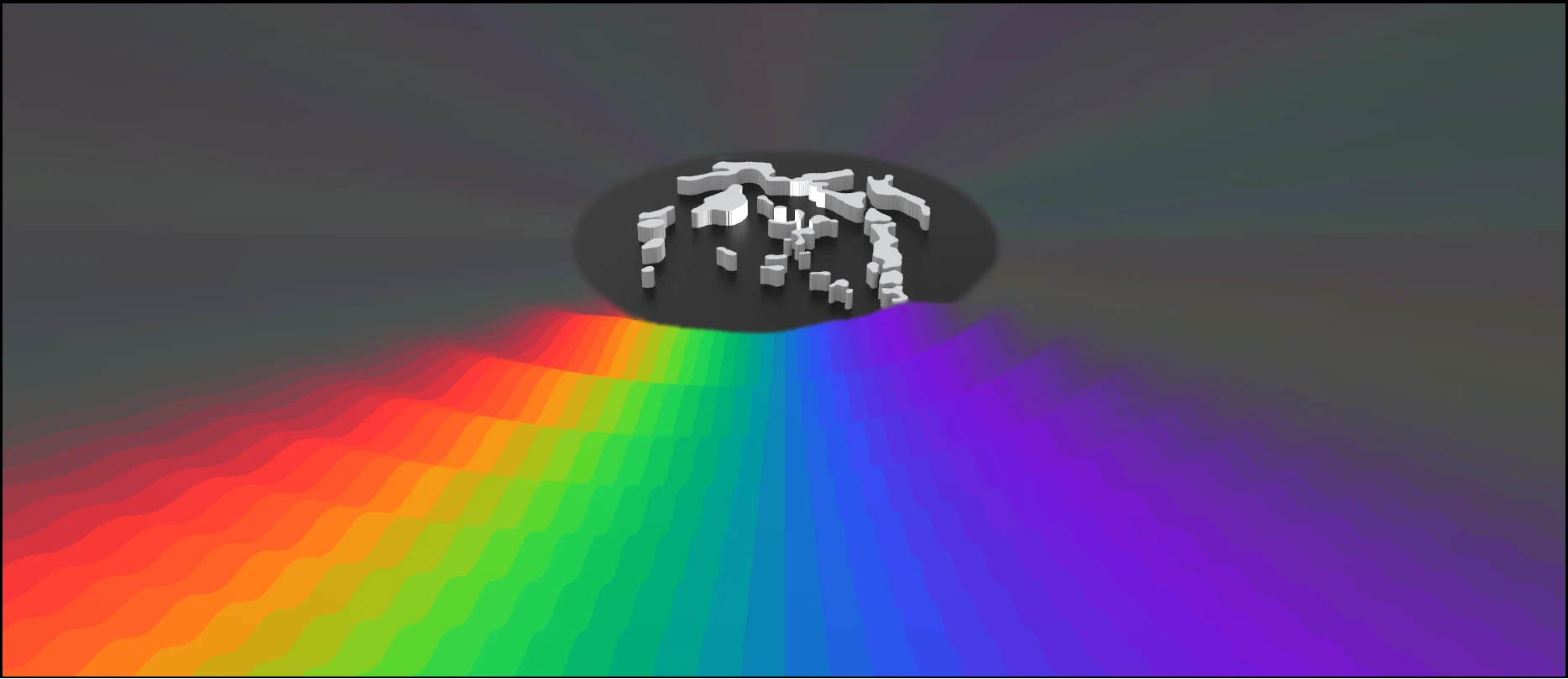
The idea of an “acoustic rainbow” may sound poetic, but it describes a concrete phenomenon: the spatial separation of a sound’s frequency components, so that each frequency band is projected in a different direction. This concept has become reality thanks to research using passive structures, without electronics, digitally optimized.
Recent work: digital morphogenesis and passive structure
A Danish team (Rasmus E. Christiansen, Ole Sigmund, Efren Fernández-Grande) published Morphogenesis of sound creates acoustic rainbows. Their device, designed through morphogenetic optimization, decomposes white noise into its components by directing each frequency into a specific direction.
Notable results: high efficiency, passive operation, and clear directional projection of the different frequency bands.
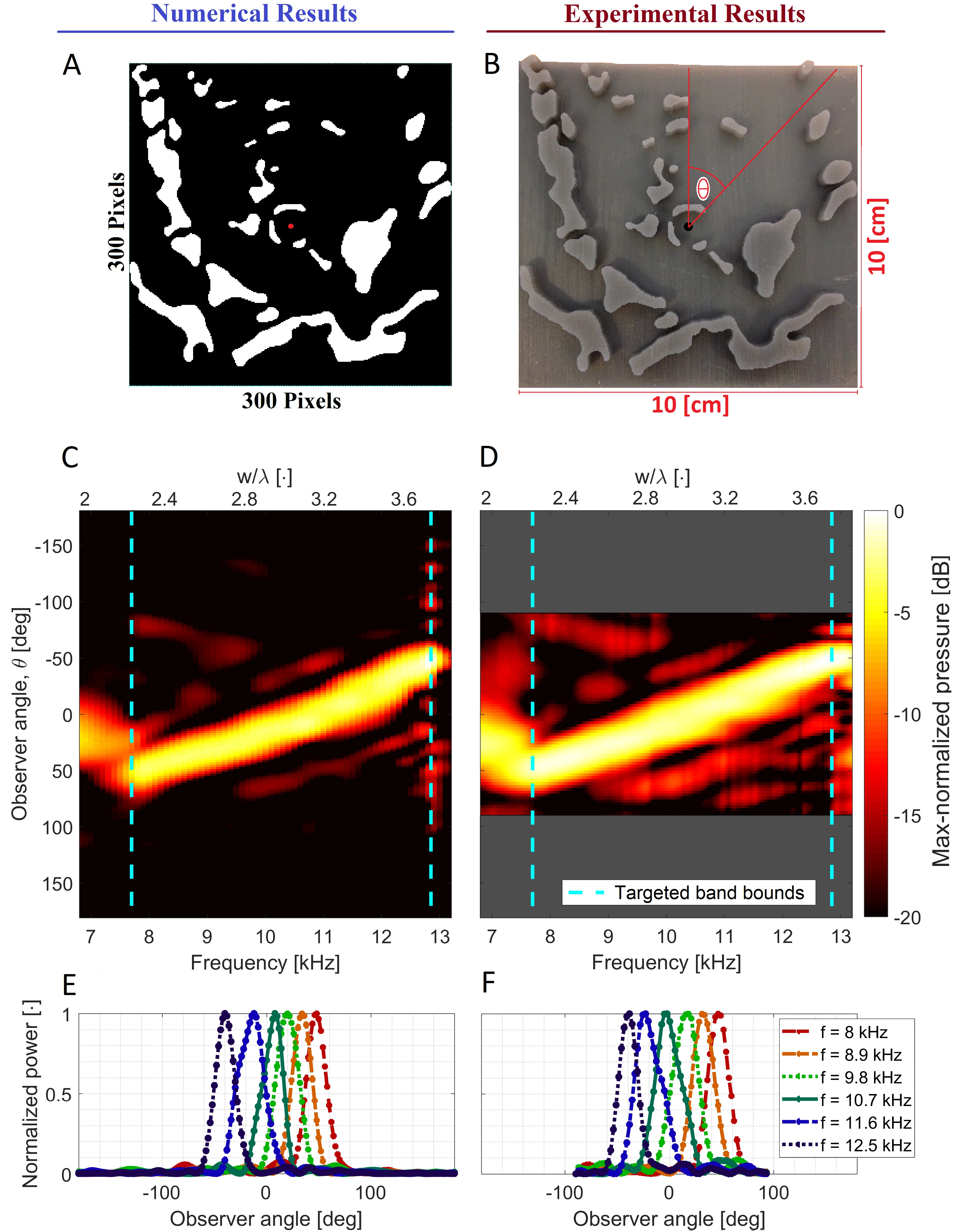
Two prototypes were developed: an “Acoustic Rainbow Emitter” (ARE) covering a frequency range of about 7600 to 12800 Hz, and a “lambda-splitter,” which separates a broadband signal into two distinct directions. Both structures were 3D printed from a single rigid material.
How it works: technical aspects
Digital morphogenesis: an optimization method that sculpts a rigid structure to achieve strong frequency dispersion.
Physical structure: hard materials designed to reflect/refract sound precisely, relying on diffraction and interference.
Frequency ranges: tests show efficiency in the audible spectrum, but limitations appear for very low frequencies.
Design process: geometry is defined through topology optimization and adjoint methods, so the structure precisely directs frequency bands. This approach allows for complex shapes impossible to design by simple intuition.
Efficiency: the device demonstrates “above unity” efficiency, meaning it radiates more effectively than the bare source in free space within the target frequency band.
Comparison with other approaches
Unlike electronic filters, DSP, or absorbing metamaterials, this device is fully passive and spatializes frequencies. It stands out through its morphological optimization and lack of active power supply.
Other work has already been done on cochlea-inspired sensors (Helmholtz resonators, graded structures, metamaterial spirals), but this device distinguishes itself by its ability to project frequencies into space with controlled directional efficiency.
Potential applications
- Acoustic capture and directional microphones
- Sound communication systems
- Passive acoustic filters
- Sensing and metrology
- Artistic creation and sound installations
Other possible uses include noise control, architectural acoustics, and the design of bio-inspired sensors.
Limits and challenges
The main challenges concern low-frequency separation, energy losses, direction dependency, manufacturing complexity, and adaptability in real-world environments.
Performance measured in the lab does not always hold under real conditions, where reflections, absorption, and ambient noise reduce efficiency. The observer’s position also plays a crucial role in the perception of spatial separation.
What research still needs to confirm
- Efficiency across the full audible spectrum
- Robustness under real usage conditions
- Cost and manufacturing feasibility
- Integration into complex acoustic environments
- Angular range of dispersion
Future research could also explore miniaturized or 3D versions, capable of operating over a wider frequency range, especially toward the low end.
Conclusion
The “acoustic rainbow” device illustrates a major advance in sound engineering: a purely passive frequency-to-space separation. Between scientific, practical, and artistic applications, it opens new perspectives but still needs to be tested and adapted for large-scale use.
And you?
Do you think this type of device could be useful in a context you know (studio, concert, sound installation)? If so, for what exactly?
Source(s) : Arxiv.org
"Any news, information to share or writing talents? Contact me!"
♥ - Joseph SARDIN - Founder of BigSoundBank.com - About - Contact